Best Post Workout Recovery Tools for Home Lifters (Foam Roller, Massage Gun, etc.)
Quick Answer
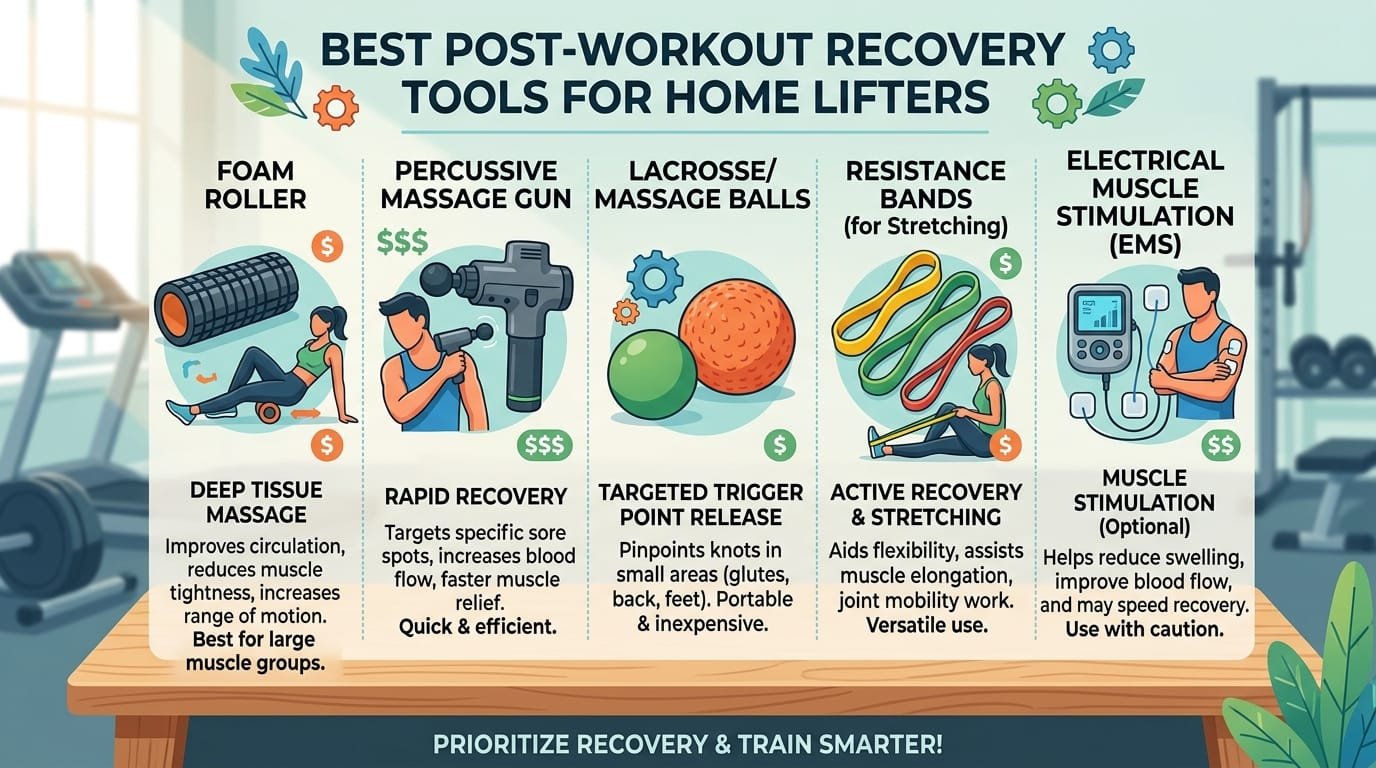
The best post workout recovery tools for home lifters are a quality foam roller, a massage gun (percussion massager), a lacrosse or massage ball, and simple mobility aids such as a stretching strap. Foam rolling and massage guns both reduce perceived muscle soreness (DOMS) by roughly 10–20% compared with passive recovery and can improve short-term range of motion. Neither dramatically accelerates true muscle repair, but both make the recovery process more comfortable and help maintain training consistency. Prioritise a firm foam roller as the foundational tool, add a massage gun for targeted spots, and use balls for precise areas the roller cannot reach. Consistency of use matters more than owning every gadget.
Why Recovery Tools Matter for Home Lifters
Hard training creates microscopic muscle damage, inflammation, and temporary reductions in range of motion and force output. While sleep, protein intake, and overall stress management remain the primary drivers of recovery, self-myofascial release tools can meaningfully reduce the subjective discomfort of delayed-onset muscle soreness (DOMS) and help restore mobility between sessions.
For home lifters who train frequently without access to professional massage or recovery facilities, affordable tools that can be used immediately after training or on rest days provide a practical advantage. Research comparing foam rolling and percussion therapy shows similar acute benefits for soreness reduction and flexibility, with effect sizes that are modest but consistent (massage guns vs foam rollers research summary).
Comparison of the Most Useful Home Recovery Tools
| Tool | Best For | Evidence Snapshot | Cost Range | Portability | Learning Curve | Recommended Priority |
|---|---|---|---|---|---|---|
| Foam Roller | Large muscle groups (quads, hamstrings, back, calves) | Reduces DOMS ~10–20%; improves short-term ROM | $15–$50 | Moderate | Low | Highest – start here |
| Massage Gun | Targeted spots, hard-to-reach areas, convenience | Similar soreness reduction; faster per muscle group | $50–$300+ | High | Low–moderate | High – excellent second tool |
| Lacrosse / Massage Ball | Glutes, feet, upper back, specific trigger points | Effective for precise pressure | $5–$20 | Excellent | Low | High |
| Massage Stick / Roller Stick | Calves, IT band, forearms | Good for linear muscle groups | $15–$40 | High | Low | Medium |
| Stretching Strap / Band | Assisted stretching & mobility | Supports flexibility work | $10–$25 | Excellent | Low | Medium |
| Compression Gear | Passive recovery (optional) | Mixed evidence; comfort benefit | $20–$200+ | High | Low | Lower priority |
Foam Roller – The Foundational Tool
A firm foam roller remains the highest-value recovery purchase for most home lifters. It allows efficient treatment of large muscle groups and requires no batteries or charging.
How to Use Post Workout
- Spend 30–90 seconds per major muscle group.
- Roll slowly and pause on tender spots for 20–30 seconds.
- Maintain steady breathing and avoid rolling directly over joints or the lumbar spine in a way that causes pain.
- Common areas: quadriceps, hamstrings, calves, glutes, upper back, and thoracic spine.
Evidence Notes
Foam rolling reliably reduces perceived soreness and can improve range of motion acutely. It does not appear to accelerate the return of maximal strength more than passive rest, but the reduction in discomfort supports better training consistency (foam rolling recovery findings).
Choose a roller with moderate-to-high density. Softer rollers compress too easily and lose effectiveness; extremely hard rollers can be unnecessarily painful for beginners.
Massage Gun (Percussion Massager)
Massage guns deliver rapid percussive strokes that many users find more convenient and targeted than foam rolling. They excel at treating specific hotspots the roller cannot easily reach (e.g., deep in the glutes, around the shoulder blades, or the sole of the foot).
How to Use Post Workout
- Apply 30–60 seconds per muscle group or hotspot.
- Use light-to-moderate pressure — the tool should not cause sharp pain.
- Keep the head moving rather than holding it stationary for long periods.
- Avoid bony areas, the neck, and any acute injury sites.
Evidence Notes
Percussion therapy produces similar reductions in soreness and improvements in flexibility compared with foam rolling. It is often faster per muscle group and preferred by people who want targeted treatment without getting on the floor (percussion vs rolling comparison).
For most home lifters a mid-range model with adjustable speeds and a few attachment heads is sufficient. Budget options have improved significantly and can deliver meaningful benefits.
Detailed guidance on selecting a cost-effective unit is available in our earlier article: Best Massage Gun for Post-Workout Recovery on a Budget.
Lacrosse Ball or Massage Ball
A simple hard ball is one of the most cost-effective recovery tools available. It allows precise pressure on the glutes, piriformis, plantar fascia, upper back, and pectoral areas that large rollers miss.
Primary Uses
- Glute and hip external rotator release
- Foot (plantar fascia) work
- Thoracic spine and scapular area
- Chest and anterior shoulder soft-tissue work
Spend 30–60 seconds per spot, breathing deeply and gradually increasing pressure as tolerance allows.
Supporting Tools
Massage Stick
Useful for calves, IT band, and forearms. Allows linear rolling while standing or seated.
Stretching Strap or Long Resistance Band
Assists with hamstring, hip-flexor, and shoulder mobility work. Helpful when flexibility limits recovery positions.
Optional Compression
Compression socks or sleeves may improve comfort for some lifters, though the performance-recovery evidence remains mixed. Prioritise the active tools above first.
Step-by-Step Post Workout Recovery Routine (10–15 Minutes)
- Immediately after training, perform light walking or easy movement for 2–3 minutes.
- Foam roll major muscle groups worked that day (quads, hamstrings, glutes, back, calves) — 30–60 seconds each.
- Use a massage gun or lacrosse ball on any specific hotspots or areas the roller could not address effectively.
- Finish with 2–3 priority stretches or mobility drills (hip flexors, thoracic extension, chest opener).
- Hydrate and consume a protein-containing meal or shake within a reasonable window.
- Prioritise sleep that night — the most powerful recovery tool available.
How to Match Tools to Training Focus
- Lower-body dominant days (squats, hinges, lunges): foam roller on quads/hamstrings/glutes + ball on glutes/piriformis + calf stick or roller.
- Upper-body / shoulder days: foam roller or ball on upper back and pecs + massage gun on rear delts and rotator cuff area + band pull-aparts or face pulls for activation.
- Grip-intensive or pulling days: forearm massage stick or ball work + grip recovery awareness (see grip strength guidance).
Maintain healthy shoulder mechanics during all raising and pressing work by applying principles from safe lateral-raise technique and the shoulder health routine. Kettlebell training creates significant posterior-chain demand — pair it with thorough glute and hamstring rolling (kettlebell sizing guide).
Core work and hanging can leave the mid-section and lats needing attention; progressions toward an ab roller benefit from good recovery practices. Low-impact conditioning options are discussed in manual treadmill guidance. For band-related mobility and recovery work, refer to Resistance Bands Buying Guide.
Realistic Expectations and Evidence Summary
Both foam rolling and massage guns reduce perceived soreness and can improve short-term range of motion. The effect on actual muscle repair and strength recovery is modest. They are best viewed as tools that improve comfort and training consistency rather than magic recovery accelerators. Sleep, nutrition, and overall stress management remain far more influential (recovery modality evidence overview).
Common Mistakes
- Rolling too aggressively or too long on a single spot
- Using a massage gun on bony areas or the neck
- Expecting tools to replace sleep and protein
- Skipping recovery work entirely after hard sessions
- Buying expensive gadgets before mastering basic foam rolling
- Rolling directly over acute injuries or swollen areas
Frequently Asked Questions
Is a foam roller or massage gun better?
Both are effective. Foam rollers are better for large surface areas and cost less; massage guns are faster and more targeted. Many lifters benefit from owning both.
How soon after training should I use these tools?
Immediately post workout or within a few hours is ideal for soreness management. They can also be used on rest days.
Can these tools replace a professional massage?
They provide useful self-care but do not fully replicate the skill and adaptability of a good therapist. Use them as a regular maintenance practice.
How long should a recovery session last?
10–15 minutes is sufficient for most home lifters. Longer is not necessarily better.
Are expensive massage guns worth it?
Not for most people. Mid-range and even solid budget models deliver the majority of the benefit. Technique and consistency matter more than premium features.
Can I use these tools every day?
Yes, provided pressure remains comfortable and no sharp pain is produced. Daily light use is common and generally well tolerated.
Do recovery tools help build muscle?
Indirectly. By reducing soreness and helping you train more consistently with good quality, they support the overall process. They do not directly stimulate hypertrophy.
Final Recommendation
Equip your home gym with a firm foam roller as the foundation, add a massage gun for targeted work, and keep a lacrosse or massage ball for precise spots. Use these tools consistently after training sessions for 10–15 minutes, focusing on the muscles worked that day. Pair the tools with solid sleep, protein intake, and overall recovery habits.
When used regularly, foam rollers, massage guns, and simple massage balls meaningfully reduce the discomfort of hard training and support long-term consistency. Start with the foam roller, master basic technique, then add a massage gun if you want faster or more targeted relief. The best recovery tool is the one you actually use — make these simple practices a non-negotiable part of your home training routine for better results and fewer interrupted sessions.