How to Organize and Store Home Gym Gear in a Small Space
Quick Answer Successful organization of home gym gear in a small space rests on three non-negotiable principles: keep a dedicated training floor completely clear at all times, store heavy items low and stable, and move everything else vertical, foldable, or into hidden multi-use storage. Assign every piece of equipment a permanent “parking spot,” enforce a strict 2–5 minute reset routine after every session, and favour adjustable, foldable, and stackable tools from the start. With wall shelves, over-door hooks, under-bed bins, vertical stands, and foldable benches, even a closet, living-room corner, or 6×6-foot zone can support progressive full-body training without permanent clutter or visual chaos.
Why Storage Discipline Determines Long-Term Success
In apartments, spare bedrooms, studio living areas, or shared homes, floor space is the scarcest resource. Equipment left on the floor shrinks the usable training zone, creates trip hazards, generates constant visual stress, and quietly reduces workout frequency. Conversely, a well-organised system keeps the training area open, makes gear instantly accessible, and returns the living space to normal within minutes. Real-world small-space builds repeatedly demonstrate that the difference between a home gym that lasts for years and one that becomes abandoned clutter is almost always storage systems and habits rather than the quality of the equipment itself.
Foundational Storage Principles
- Protect a clear training zone first (minimum 6×6 ft / approximately 2×2 m of open floor).
- Store the heaviest items lowest to minimise tipping risk and maximise safety.
- Exploit vertical space — walls, doors, and height — for medium and light items.
- Prefer foldable, stackable, adjustable, or multi-use equipment.
- Give every single item a permanent, labelled home.
- Separate daily-use gear from occasional or seasonal items.
- Design a reset routine that takes no more than a few minutes and make it non-negotiable.
- Choose renter-friendly solutions (removable, freestanding, or damage-free mounting) when permanent modifications are restricted.
Comprehensive Equipment Storage Guide
| Equipment | Optimal Small-Space Storage Methods | Stored Footprint | Key Tips & Safety Notes |
|---|---|---|---|
| Adjustable dumbbells | Low dedicated stand, corner shelf, under-bench tray, or paired on floor mat | 1–2 sq ft | Never store high; keep pairs together and secure |
| Foldable bench | Vertical against wall/door, under bed, behind sofa or in closet | 6–12 inches deep | Select models that fold truly flat or stand stably |
| Resistance bands | Over-door hooks, pegboard, labelled bin, or drawer | Near zero | Group by type and resistance; prevent tangling |
| Kettlebell(s) | Floor strip, low shelf, or dedicated corner | Small | Extremely heavy — floor-level only |
| Doorway pull-up bar | Remove after use; hang inside closet or store flat | Near zero | Quick-install models ideal for shared spaces |
| Exercise mat | Rolled and stood in corner/closet, or hung on wall strap | Small cylinder | Keep clean and dry to prevent odour/mildew |
| Weight plates (if present) | Vertical plate tree or low wall-mounted pegs | Minimal floor | Balance load evenly; secure against tipping |
| Jump rope & light accessories | Hooks, small wall organizer, or basket | Minimal | Keep visible so they actually get used |
| Foam roller / recovery tools | Vertical corner, under bench, or dedicated bin | Low | Easy access increases post-workout use |
| Ab wheel or similar | Low shelf, bin, or hung | Minimal | Store with other core tools |
When selecting the primary training tools themselves, prioritise space-efficient options. Detailed guidance is available for adjustable dumbbells, resistance bands, and kettlebell sizing.
Vertical, Hidden, and Multi-Use Storage Strategies
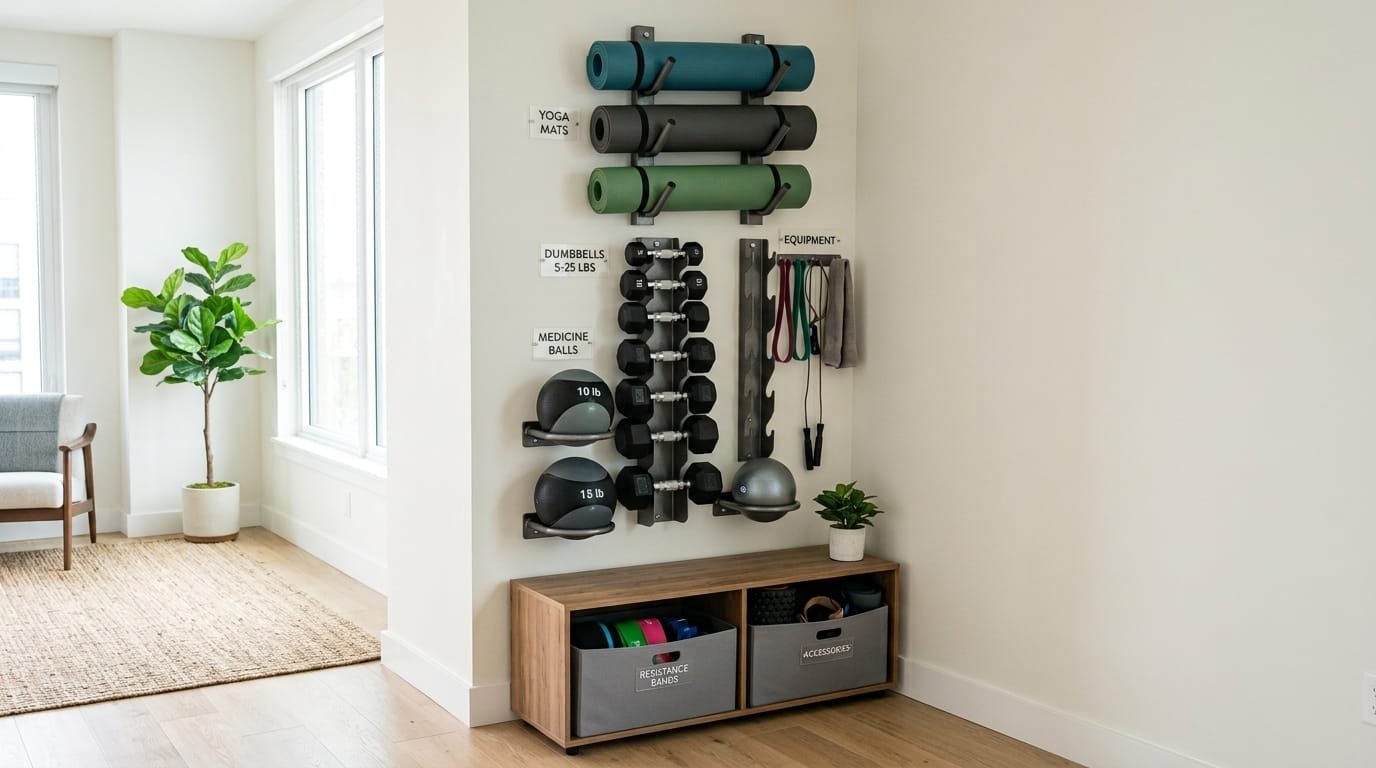
Walls and Doors (Highest Leverage)
- Over-door hooks or multi-hook racks for bands, jump ropes, straps, and light accessories — excellent renter-friendly option.
- Pegboard panels (mounted to studs or with heavy-duty removable systems) for fully customizable layouts.
- Floating shelves at mid-height for dumbbell trays, small recovery tools, or labelled bins.
- Wall-mounted straps or simple brackets for rolled mats.
Under Furniture and Closet Systems
- Under-bed storage bins or rolling drawers for mats, extra bands, and seasonal items.
- Closet floor reserved for the heaviest items (dumbbells, kettlebells).
- Hanging closet organizers or over-door systems for lighter gear.
- Narrow gaps beside refrigerators, behind doors, or beside bookcases for vertically stored benches or mats.
Furniture-Style and Rolling Solutions
- Storage benches or ottomans that double as seating and hide accessories.
- Rolling utility carts that can be wheeled into a closet or corner after training.
- Low media consoles or cabinets with internal space for bands and recovery tools.
- Coffee tables or side tables with hidden compartments for the lightest items.
Step-by-Step System to Organize Any Small Home Gym
- Completely clear the intended training zone and measure its usable dimensions.
- Inventory every piece of equipment and categorise by weight and frequency of use (daily, weekly, occasional).
- Assign a permanent storage location to each item using the “heavy low, light vertical or hidden” hierarchy.
- Install or position all storage solutions (hooks, shelves, stands, bins) before placing any gear.
- Place items in their assigned homes and photograph the finished organised setup for reference.
- Create and practice a written or mental post-workout reset checklist that takes 2–5 minutes.
- Perform a full set-up and pack-away cycle several times until the process feels automatic.
- Live with the system for 1–2 weeks and note any friction points.
- Adjust locations or add simple organisers to eliminate friction.
- Schedule a quarterly review to remove unused items and re-optimise as equipment evolves.
The Three-Zone Method
- Training Zone: Sacred clear floor space used only for movement. Nothing lives here permanently.
- Daily-Access Storage Zone: Immediately adjacent low or wall storage for items used in almost every session (dumbbells, primary bands, mat).
- Overflow / Occasional Zone: Higher shelves, under-bed space, deep closet areas, or another room for rarely used items.
Maintaining this separation prevents daily gear from slowly invading the training floor and keeps low-frequency items from creating constant visual noise.
Scenario-Specific Layout Examples
Closet-Centric Setup Heaviest items (dumbbells, kettlebell) on the closet floor. Folded bench standing vertically inside or just outside. Bands on over-door hooks. Mat rolled in a corner. Pull-up bar hung inside the closet or stored flat. Entire gym disappears when the door closes.
Living-Room Corner Setup Low dumbbell stand or tray against the wall. Folded bench stored behind a sofa or door. Wall hooks or a small pegboard section for bands and accessories. Mat stored under furniture or rolled nearby. Visual impact remains minimal when not in use.
Spare Bedroom Hybrid One wall dedicated to vertical storage (shelves + hooks). Opposite side for low heavy storage. Central clear training zone. Under-bed area used for overflow. Door remains usable and the room can still function for other purposes.
Safety, Noise, and Renter Considerations
- Always place protective mats under heavy stored items to shield floors and reduce transmitted vibration.
- Verify that freestanding racks and shelves are stable and not overloaded.
- Prefer removable doorway bars and freestanding storage when leases restrict permanent modifications.
- Keep the heaviest loads at floor level, especially in homes with children or pets.
- Maintain clear walkways so the organised system does not introduce new obstacles or hazards.
- In multi-level buildings, extra floor protection under lifting and storage zones helps minimise noise complaints.
Integrating Storage with Training Quality and Recovery
Keep bands highly visible and accessible so they are actually used for warm-ups, face pulls, and assistance work. Store grip-training tools where they support pull-up and carry performance — see grip strength guidance. Position recovery tools (foam roller or budget massage gun) so post-session use becomes the path of least resistance. Give core tools such as an ab roller a dedicated low or vertical home. Maintain shoulder-friendly technique on pressing and isolation movements by applying principles from lateral raise guidance. Any compact conditioning tool related to manual treadmill use needs its own vertical or under-furniture storage plan from day one.
External real-world storage examples and small-space organisation systems can be explored further in resources such as Fitness Volt’s small home gym storage ideas and Home Gym Foundry’s small-space equipment guidance.
Maintenance and Long-Term Habits
- Wipe down equipment before storing to prevent sweat-related odour and corrosion.
- Periodically check hooks, shelves, and stands for stability.
- Re-evaluate the system every 8–12 weeks as strength levels and equipment change.
- Ruthlessly remove or relocate anything that has not been used in the previous month.
- Treat the reset routine with the same seriousness as the workout itself.
Common Organization Failures and How to Fix Them
- Leaving dumbbells and benches on the training floor → Assign permanent low storage and enforce reset.
- Storing heavy items high → Immediately move them to floor level.
- Random unlabelled bins → Categorise and label so retrieval takes seconds.
- Buying organisers before assigning homes → Decide locations first, then select storage tools.
- Skipping the post-workout reset → Make it a non-negotiable final step of every session.
- Overloading freestanding units → Respect weight ratings and distribute loads.
Frequently Asked Questions
How much clear floor space do I really need? Protect at least a 6×6 ft (approximately 2×2 m) open training zone. Storage can occupy walls, vertical height, under furniture, and closet space around it.
What single storage upgrade gives the biggest return? A reliable low solution for dumbbells/kettlebells combined with over-door or wall hooks for bands and accessories. A truly foldable bench that stores vertically is a close second.
Are pegboards practical in rentals? Yes when using damage-free mounting methods or when light wall modifications are permitted. Otherwise, over-door and freestanding options deliver most of the organisational benefit.
How should I store a barbell and plates in a very small space? Vertical plate trees and vertical or wall-oriented bar storage are the most efficient. Introduce these only after progressing beyond a primarily dumbbell-based setup.
How long should the reset routine take? Target 2–5 minutes. If it regularly takes longer, simplify locations or reduce the number of items that leave storage.
Can the storage system look intentional rather than like gym clutter? Yes. Matching colours, closed bins or cabinets, furniture-style stands, and consistent alignment help the setup blend into living spaces.
What do I do with gear I almost never use? Move it to true overflow storage (under bed, high shelf, or another location) or sell/donate it to reclaim both physical and mental space.
How often should I reorganise? Perform a light review monthly and a more thorough reset every 8–12 weeks, or whenever new equipment is added.
Final Recommendation
Organizing and storing home gym gear in a small space succeeds when the training floor remains sacred, heavy items stay low and secure, vertical and hidden storage are fully exploited, and a rapid reset routine becomes automatic. Choose foldable and adjustable equipment from the beginning, assign every item a permanent home, and strictly separate daily-use gear from occasional items.
Implement the three-zone method, install simple vertical and under-furniture solutions, and practice the complete set-up and pack-away cycle until it requires almost no willpower. When storage is solved, training consistency rises, safety improves, and the living environment stays calm and functional. Begin today by clearing your training zone, giving every piece of gear a designated spot, and committing to the reset habit — your small-space gym will transform from a source of clutter into a highly effective, sustainable training system.