Can Hand Grippers Really Increase Forearm Size? What the Evidence Shows
Quick Answer Yes, hand grippers can increase forearm size, but the growth is typically modest and concentrated in the finger flexors (the muscles responsible for closing the hand) rather than the entire forearm. Progressive gripper training reliably improves crush-grip strength and can produce measurable increases in mid- and lower-forearm circumference, especially in beginners. For balanced, noticeable size across the whole forearm—including the upper forearm and brachioradialis—grippers work best as one tool among several, paired with wrist curls, reverse/hammer curls, thick-grip work, and loaded carries. Relying on grippers alone yields limited, somewhat lopsided development.
Forearm Anatomy: What Grippers Actually Load
The forearm contains two primary muscular compartments plus a key lateral muscle:
- Anterior (flexor) compartment – Includes the flexor digitorum superficialis and profundus (finger flexors), wrist flexors, and pronators.
- Posterior (extensor) compartment – Wrist and finger extensors.
- Brachioradialis – The prominent muscle on the radial side that contributes heavily to visible forearm thickness and elbow-flexion strength.
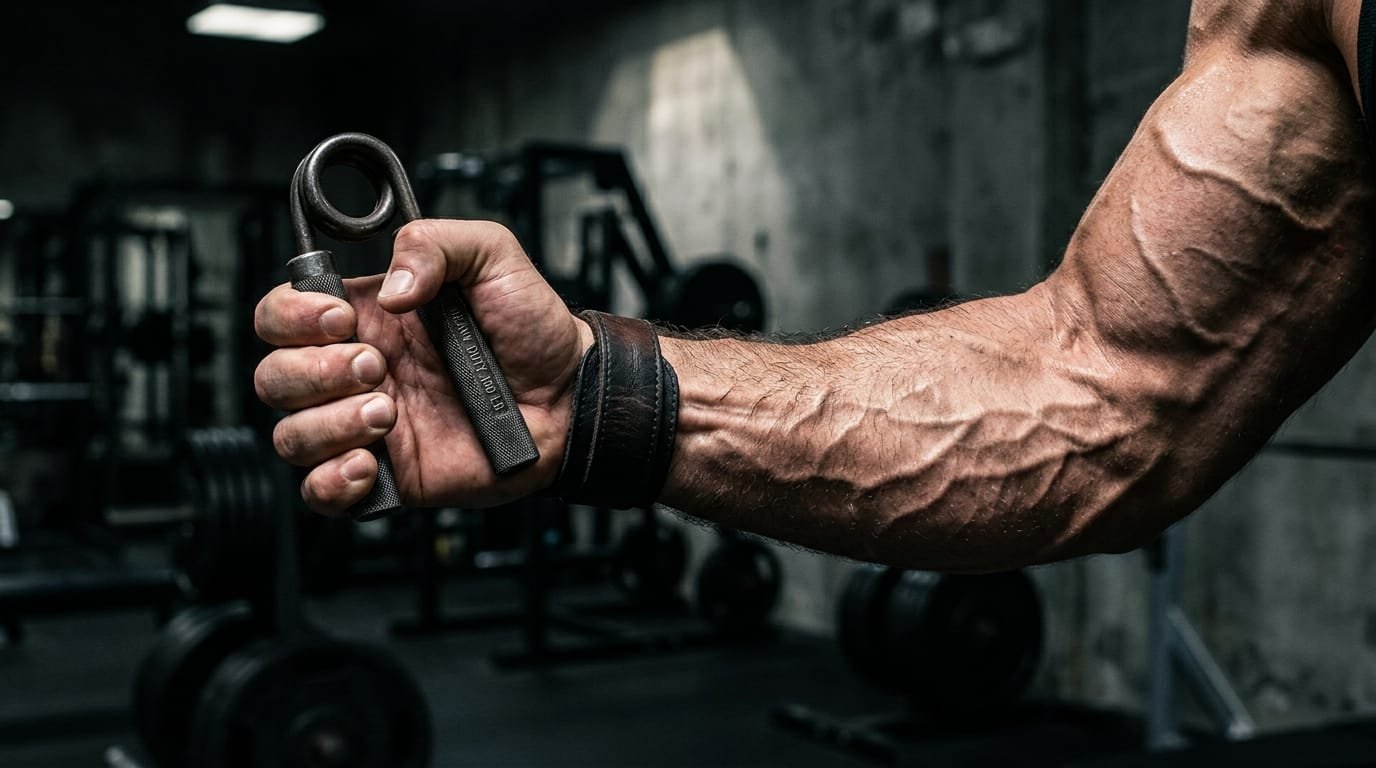
Hand grippers primarily challenge the finger flexors in a crush-grip pattern. When the wrist is held in extension, they also load the wrist flexors to a degree and recruit intrinsic hand muscles. They provide minimal direct stimulus to the extensors or brachioradialis. This anatomical specificity explains why gripper-only programs can add density and some size to the lower and mid-forearm while leaving overall balance incomplete.
What the Scientific and Practical Evidence Shows
Direct randomised trials on gripper-only hypertrophy remain limited, yet available studies and well-documented experiments paint a consistent picture:
- Progressive hand-gripper protocols commonly produce 20–30% increases in maximal crush-grip strength over 6–12 weeks in untrained or recreational participants.
- In one controlled intervention using a custom progressive gripper device, participants increased dynamic gripper 1RM by 26.5% after six weeks of heavy, low-repetition training; estimated forearm muscle mass rose 2.8% (non-significant).
- A practical 30-day comparison of daily gripper work, rice-bucket training, and gym-based forearm routines found that the gripper protocol produced the largest gains in mid-forearm (+1.6 cm) and lower-forearm/wrist (+1.2 cm) circumference in a beginner, along with the best pinch-grip improvement.
- A 6-week combined gym-plus-climbing study reported statistically significant forearm circumference increases (right forearm from 24.6 cm to 25.4 cm) alongside grip-strength gains, illustrating that multi-planar loading accelerates visible size changes (see the open-access GRIP-6 study).
A comprehensive evidence-based review of grip training published on Stronger by Science notes that hand grippers are particularly useful for dynamically loading the finger flexors at favourable muscle lengths and can be performed in almost any environment, allowing extra volume with low systemic fatigue. They are not, however, the single most efficient tool for maximal overall forearm hypertrophy.
Why Grippers Alone Produce Limited and Uneven Size
Muscle hypertrophy occurs preferentially in the fibres that experience sufficient mechanical tension. Because grippers emphasise one primary action—finger flexion—other regions receive inadequate stimulus. Without dedicated wrist-extension work the posterior compartment lags. Without elbow-flexion variations (hammer or reverse curls) the brachioradialis remains under-stimulated. The practical result is improved crush-grip strength and some lower-forearm density, but incomplete aesthetic and functional development.
Comparison of Forearm Training Approaches
| Method | Primary Muscles Targeted | Strength Emphasis | Size Potential | Convenience | Best Application |
|---|---|---|---|---|---|
| Hand grippers | Finger flexors (crush grip) | High (crush) | Modest (mid/lower forearm) | Excellent | Portable crush-grip overload |
| Wrist curls & extensions | Wrist flexors & extensors | Moderate | High for balanced thickness | High | Direct circumferential growth |
| Hammer / reverse curls | Brachioradialis + flexors | Good | High for upper-forearm thickness | High | Visible “Popeye” development |
| Farmer carries / dead hangs | Support grip + full forearm | High (support) | Good overall | Moderate | Functional size and endurance |
| Thick-grip or pinch work | Pinch + support | High | Good | Moderate | Variety and additional thickness |
| Combined multi-planar program | All major forearm regions | Highest | Highest | Moderate | Maximal balanced development |
Step-by-Step Program to Maximise Forearm Size Using Grippers
- Choose progressive resistance – Use adjustable grippers or a full set spanning light to heavy so overload remains possible for months.
- Train crush grip 2–4 sessions per week – Perform 3–5 sets of 5–12 repetitions. Heavier loads (5–8 reps) favour strength; moderate loads (8–12) favour hypertrophy. Control the eccentric phase.
- Add wrist flexion and extension – 2–3 sets of 12–20 full-range repetitions with dumbbells or a barbell.
- Include brachioradialis work – Hammer curls or reverse curls for 2–3 sets of 8–15 reps.
- Incorporate support and pinch elements – Farmer carries, dead hangs, or plate pinches 1–2 times weekly.
- Progress systematically – Increase resistance, repetitions, or sets once current loads become manageable.
- Manage recovery – Forearms recover relatively quickly, yet high-volume or daily hard sessions can irritate the elbows or wrists. Allow 48 hours between intense efforts when volume is elevated.
- Measure progress – Track circumference at consistent upper, mid, and lower points every 4 weeks, alongside gripper strength.
A minimal effective dose for most trainees is 6–10 hard gripper sets plus 4–6 sets of direct wrist work per week. More advanced individuals may benefit from higher distributed volumes.
Realistic Timeline and Expectations
- Weeks 1–3 – Primarily neural adaptations; strength rises before visible size.
- Weeks 4–8 – Noticeable pump and early circumference changes, especially in previously untrained forearms.
- Months 3–6 – Clearer size and density when grippers are combined with complementary exercises and progressive overload.
- Long-term – Genetics influence the upper limit, but consistent multi-planar training produces meaningful growth for nearly everyone.
Beginners often see the fastest relative changes. Trained lifters require more precise progressive overload and higher total volume to continue advancing.
Common Mistakes That Cap Results
- Using only light grippers for very high repetitions (builds endurance more than hypertrophy).
- Neglecting the extensors and brachioradialis.
- Failing to increase resistance over successive weeks.
- Training forearms intensely every day without monitoring joint comfort.
- Expecting dramatic growth from grippers in isolation.
- Ignoring recovery, sleep, and protein intake.
Integrating Grip and Forearm Training with the Rest of Your Program
Hand grippers complement nearly every other training tool. They improve pulling strength for kettlebell swings, rows, and carries, and they support heavier loading with adjustable dumbbells. Stronger grip enhances performance on ab roller rollouts and hanging variations. Core stability and proper bracing transfer directly to better force application during carries and hangs.
Recovery tools such as a budget massage gun can help manage residual forearm and elbow tension. Light cardio on a manual treadmill or mobility work with resistance bands supports overall recovery. Continue applying the shoulder-mechanics principles from your lateral raise guidance so upper-body sessions remain balanced. Direct gripper work also reinforces the practical advice already covered in your hand grip strengthener tips and benefits article.
Frequently Asked Questions
Do hand grippers build impressive forearms by themselves? They can add noticeable size to the finger flexors and lower forearm, but balanced, high-level development almost always requires additional wrist-flexion/extension and brachioradialis work.
How heavy should the gripper be for size gains? Heavy enough that sets of 5–12 repetitions reach near-failure. Adjustable models simplify long-term progression.
Is daily gripper training effective or risky? Low-volume daily work is often well tolerated; high-intensity daily sessions increase the risk of elbow or wrist irritation. Monitor symptoms and insert recovery days as needed.
How long before visible size appears? Strength improves within weeks. Measurable circumference changes typically require 6–12 weeks of progressive training and appear faster in beginners.
Are grippers superior to wrist curls for hypertrophy? Grippers excel at crush-grip strength and lower-forearm density. Wrist curls and extensions are generally more effective for overall forearm thickness. Optimal programs use both.
Do grippers transfer to deadlifts and pull-ups? Yes—they improve crush and support endurance. Specific heavy holds and farmer carries usually transfer even more directly to those lifts.
Can women benefit equally from gripper training? Yes. The same progressive principles apply; absolute size gains may differ due to hormonal and genetic factors, but relative strength and shape improvements are readily achievable.
Final Recommendation
Hand grippers can and do increase forearm size—particularly in the finger flexors and mid-to-lower forearm—when resistance is progressed over time. The evidence supports reliable strength gains and modest hypertrophy. For the fullest, most balanced development, treat grippers as a convenient, effective component of a broader forearm program that also includes wrist flexion and extension, brachioradialis work, and support or pinch loading.
Select progressive grippers, train them 2–4 times per week near failure, add complementary exercises, track both strength and circumference, and recover adequately. Consistency over months produces results that light, non-progressive squeezing never will. Integrate smart gripper work with the rest of your training and recovery habits, and your forearms will become both stronger and thicker.