How Arm Path Affects Chest Activation in Bench Press Variations
Quick Answer Arm path Affects Chest Activation in Bench Press Variations—primarily the combination of elbow flare/tuck angle and grip width—directly influences which regions of the pectoralis major are emphasised and how much overall chest contribution occurs relative to the triceps and anterior deltoids. A moderate elbow angle of roughly 45–70° with a medium-to-wide grip (approximately 1.5× biacromial distance) tends to maximise sternocostal (mid/lower) chest activation while remaining joint-friendly for most lifters. Narrower grips and more tucked elbows increase clavicular (upper) chest and triceps demand. Extreme flaring or excessive tucking can reduce chest contribution or elevate injury risk. Adjusting arm path is one of the most practical ways to bias different portions of the chest without changing the exercise entirely.
Understanding Arm Path in the Bench Press
Arm path describes the trajectory of the upper arms (humeri) relative to the torso throughout the entire press. The key variables are:
- Shoulder abduction angle (how far the elbows flare away from the body)
- Grip width (which largely determines the abduction angle at the bottom of the lift)
- Elbow position relative to the wrists (vertical forearm alignment is ideal)
- Resulting bar path (slight natural arc toward the upper chest/shoulders versus a more vertical line)
These factors change the moment arms at both the shoulder and elbow joints and alter the length-tension relationship of the different fibre regions of the pectoralis major. Electromyography (EMG) studies consistently demonstrate measurable differences in muscle activation across grip widths and elbow positions. Research published in the Journal of Strength and Conditioning Research and related biomechanical analyses confirms that grip width and arm path meaningfully affect the relative contribution of the clavicular, sternocostal, and abdominal heads of the pectoralis major as well as the triceps and anterior deltoid.
How Grip Width and Elbow Flare Change Chest Activation
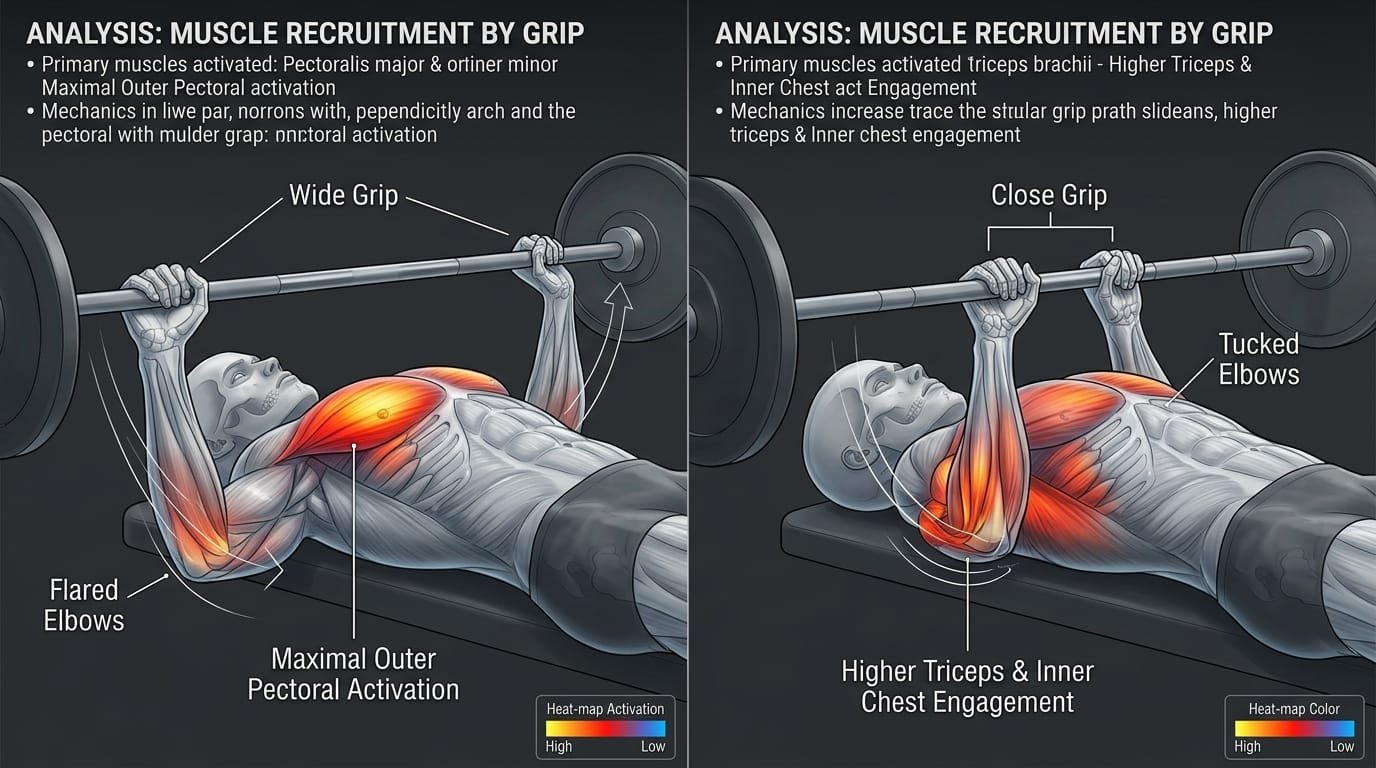
Wider Grip / Greater Elbow Flare (approximately 70–90° of shoulder abduction) A wider grip increases the horizontal-adduction demand placed on the pectoralis major. EMG data often show elevated activity in the sternocostal (mid and lower) fibres. The relative contribution of the triceps decreases, and the range of motion shortens slightly. However, taking the elbows all the way to a full 90° flare can increase stress on the anterior shoulder structures and is generally not recommended for long-term joint health.
Medium Grip / Moderate Elbow Angle (approximately 45–70°) This range provides the most balanced stimulus across the pectoralis major for the majority of lifters. It allows strong chest contribution while keeping the glenohumeral joint in a more sustainable position. Many coaches and researchers treat a moderate arm path as the default for both hypertrophy and general strength development.
Narrow Grip / Tucked Elbows (approximately 30–45° or less) A narrower grip increases the elbow-extension demand and therefore elevates triceps involvement. It frequently raises relative activation of the clavicular (upper) head of the pectoralis major compared with the sternocostal head. The range of motion lengthens. Some lifters with specific shoulder anatomy or previous irritation find a more tucked position more comfortable, although absolute chest loading is typically reduced.
Multiple studies comparing grip widths have found that narrower grips tend to increase EMG activity in the clavicular head of the pectoralis major and the lateral head of the triceps, while wider grips favour the more abdominal/sternal portions and produce higher shoulder horizontal-adduction moments. These patterns appear consistently across flat-bench variations examined in the literature (see, for example, analyses summarised in resources such as those from the Journal of Strength and Conditioning Research and related EMG reviews).
Interaction of Arm Path with Bench Angle
Arm path does not operate in isolation. Bench inclination further modulates regional chest activation:
- Flat bench (0°) – Produces strong overall pectoralis major stimulus. Medium-to-wide grips emphasise the sternocostal head most effectively.
- Low-to-moderate incline (15–30°) – Increases clavicular-head and anterior-deltoid contribution. A slightly more moderate arm path often feels natural and productive here. Research indicates that approximately 30° can maximise upper-pectoralis activation relative to steeper angles.
- Steeper inclines (>45°) – Shift emphasis heavily toward the anterior deltoids and reduce overall pectoralis major involvement.
- Decline angles – Can further bias the lower fibres, especially when paired with a wider grip and appropriate arm path.
A practical synthesis of the EMG literature is that a flat bench performed with a moderate-to-wide grip remains one of the highest overall activators of the pectoralis major, while a roughly 30° incline with a controlled arm path is particularly effective for the upper chest.
Comparison of Common Arm-Path Variations
| Variation | Typical Elbow Angle | Primary Chest Emphasis | Triceps Demand | Shoulder Stress Potential | Best Primary Use Case |
|---|---|---|---|---|---|
| Wide grip, flared elbows | 70–90° | Sternocostal (mid/lower) | Lower | Higher | Pure mid/lower chest hypertrophy |
| Medium grip, moderate path | 45–70° | Balanced across pec heads | Moderate | Moderate | Default strength & size work |
| Close grip, tucked elbows | 30–45° | Clavicular (upper) + triceps | Higher | Often lower | Triceps emphasis or shoulder relief |
| Incline + moderate arm path | 45–60° | Clavicular head | Moderate | Moderate | Upper-chest specialisation |
| Decline + wider arm path | 60–75° | Lower sternocostal fibres | Moderate | Moderate | Lower-chest emphasis |
Step-by-Step Guide to Optimising Your Arm Path
- Establish a stable base Retract and depress the scapulae, plant the feet firmly, and create a slight natural arch. This scapular position provides a solid platform so the arm path can remain consistent.
- Select a starting elbow angle Begin with a moderate 45–60° flare. This is the most productive and joint-friendly zone for the majority of lifters seeking balanced chest activation.
- Match grip width to the desired elbow angle A wider grip naturally produces more flare; a narrower grip produces more tuck. At the bottom of the press the forearms should be roughly vertical when viewed from both the front and the side.
- Control the bar path Lower the bar to the lower-chest/sternum region with a slight natural arc. Press back in a path that keeps continuous tension on the chest rather than allowing the bar to drift excessively toward the face or hips.
- Keep the arm path consistent throughout the repetition Avoid letting the elbows drift outward or collapse inward during the sticking point. Consistency preserves the intended regional bias.
- Test and compare systematically Spend several sessions on one arm path, record performance, chest “feel,” and joint comfort, then switch to a different variation and compare.
- Use video feedback Film from both the side and the front. Visual confirmation of elbow angle and forearm alignment is far more reliable than internal feel alone.
Practical Programming Recommendations
- Main chest strength/hypertrophy day – Medium-to-wide grip flat bench as the primary lift.
- Upper-chest focus – Incline barbell or dumbbell press with a moderate arm path.
- Triceps or lockout emphasis – Close-grip bench press or floor press with tucked elbows.
- Shoulder-friendly option – Slightly narrower grip or dumbbells that allow a more neutral wrist and arm path.
- Rotate primary arm-path variations across training blocks rather than changing every session so progressive overload remains clear and measurable.
Integrating Arm-Path Awareness with the Rest of Your Training
Understanding and controlling arm path improves every pressing variation you perform with adjustable dumbbells and helps you select appropriate loading when using kettlebell floor presses or other hybrid movements. Strong grip endurance supports consistent bar control across different widths. Core stability developed through ab roller variations keeps the torso rigid so the arm path stays intentional rather than compensatory.
Recovery tools such as a budget massage gun can help manage residual chest, shoulder, and triceps tension after heavy pressing. Light cardio on a manual treadmill or mobility flows with resistance bands aid recovery between sessions. Continue applying the shoulder-mechanics principles from your lateral raise guidance so isolation work reinforces rather than conflicts with the arm paths you use under the barbell.
Common Mistakes Related to Arm Path
- Flaring the elbows to a full 90° on every set in the belief that “more flare equals more chest”
- Excessively tucking the elbows and then wondering why the chest feels less involved
- Changing grip width without adjusting elbow position, creating poor forearm-to-wrist alignment
- Allowing the elbows to drift during the sticking point
- Ignoring individual shoulder anatomy, mobility, and previous injury history when selecting an arm path
- Using the same extreme path for both heavy strength work and higher-repetition hypertrophy work
Frequently Asked Questions
Does a wider grip always produce more chest activation? It often increases sternocostal contribution and horizontal-adduction demand, but extreme widths can reduce overall force production and raise shoulder stress. A moderate-to-wide grip is usually the practical optimum. Supporting EMG comparisons appear in studies such as those discussed in the Journal of Strength and Conditioning Research.
Is the “elbows at 45 degrees” cue universal? It is an excellent starting reference for most people, but individual anthropometry and shoulder comfort may favour a slightly more or less flared position. Treat it as a guideline, not a rigid rule.
Can consistent differences in arm path produce noticeable hypertrophy differences over time? Yes. Regular use of wider paths tends to favour mid- and lower-chest development, while narrower or incline variations better target the clavicular head. Both have a place in a complete program.
Should I use the same arm path for dumbbell and barbell presses? The underlying principles are similar, but dumbbells allow a more natural arc and neutral wrist position. Many lifters can adopt a slightly more tucked path with dumbbells while still achieving strong chest activation.
How do I know if my current arm path is contributing to shoulder irritation? Pain at the front or top of the shoulder, especially near the bottom of the press or during the ascent, often signals excessive flare or inadequate scapular stability. Narrow the grip or reduce flare, improve scapular positioning, and reassess.
Do incline and decline angles override the effects of arm path? They interact with arm path rather than completely overriding it. The same grip and elbow strategy will produce different regional emphases on flat, incline, and decline benches.
Final Recommendation
Arm path is one of the most powerful yet frequently overlooked variables in bench-press programming. A moderate elbow angle (roughly 45–70°) paired with a medium-to-wide grip maximises balanced pectoralis major activation for most lifters while keeping the shoulders in a sustainable position. Narrower paths shift emphasis toward the upper chest and triceps; wider paths bias the mid and lower fibres.
Experiment deliberately, film your sets from multiple angles, and prioritise long-term joint health alongside muscle stimulus. When arm path is chosen intentionally rather than left to chance, every bench-press variation becomes a more precise tool for building a stronger, more complete chest.
Select the path that matches your current training goal, execute it with consistency, and adjust only when you have clear feedback from performance, recovery, and joint comfort. Your chest development—and the longevity of your pressing—will both benefit.