How to Select the Right Weight Vest for Running or Strength Training
Quick Answer For running, choose a slim, closely fitted vest (often fixed-weight or finely adjustable pocket-style) loaded at 5–10% of body weight to minimize bounce and gait disruption. For strength training and calisthenics, select a durable adjustable or plate-carrier vest that allows progressive loading up to 10–20% of body weight (or higher for advanced users) while maintaining freedom of movement. Prioritize secure fit, even weight distribution, breathable materials, and shoulder/waist adjustability. Start light, progress gradually, and match the vest style to your primary activity.
Why a Weight Vest Is a Powerful Training Tool
A weight vest adds external load close to your center of mass, increasing the demand of bodyweight movements, walking, running, or rucking without requiring additional equipment. It improves work capacity, builds bone density, enhances core stability, and allows progressive overload for exercises such as push-ups, pull-ups, squats, lunges, and dips. When used correctly it complements free-weight training with adjustable dumbbells, a weight bench, or an adjustable kettlebell.
The key is selecting a vest that matches the intended activity. A vest ideal for heavy strength work often performs poorly for running, and a running-specific vest may lack the capacity needed for progressive strength training. Independent testing from sources such as Outdoor Gear Lab and Garage Gym Reviews consistently shows that fit and intended use matter more than maximum capacity alone.
Main Types of Weight Vests
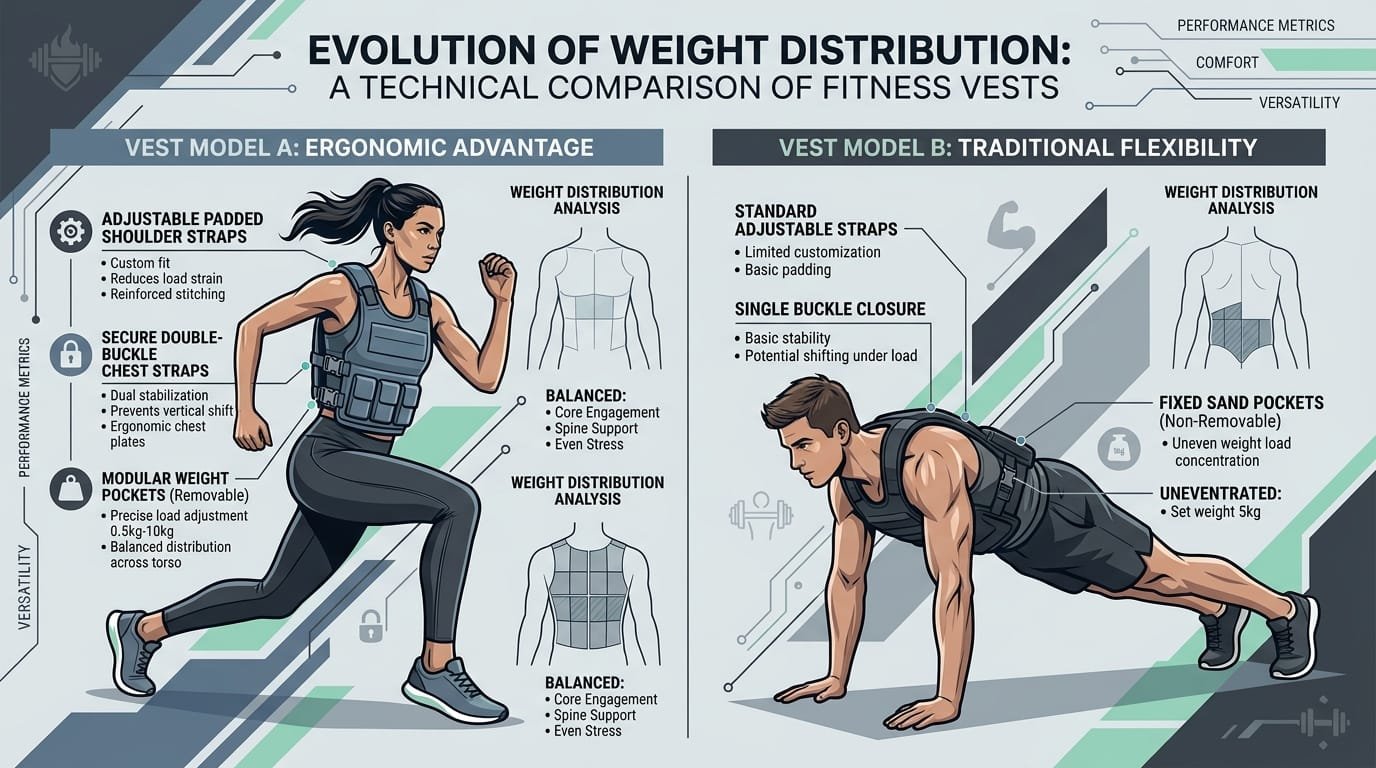
Fixed-Weight Vests Pre-loaded with a set amount of weight (often sand, steel shot, or solid plates sewn in). Simple, low-profile, and usually more comfortable for continuous movement such as running or walking.
Adjustable Pocket-Style Vests Feature multiple small pockets that accept individual bars, packets, or small plates. Allow fine weight increments and relatively even distribution around the torso.
Plate Carriers Designed to hold larger rigid plates (front and/or back). Popular for rucking, CrossFit-style workouts (e.g., Murph), and heavier loading. Offer a slim profile but less conformity to the body during twisting or bending movements.
Comparison: Running vs. Strength Training Needs
| Factor | Running / Cardio Focus | Strength / Calisthenics Focus |
|---|---|---|
| Ideal Load | 5–10% of body weight | 10–20%+ of body weight |
| Vest Style Preference | Slim fixed or finely adjustable | Adjustable or plate carrier |
| Bounce Resistance | Critical | Important but secondary |
| Range of Motion | High (arm swing, torso rotation) | High (push-ups, pull-ups, squats) |
| Durability Priority | Moderate to high | Very high |
| Breathability | High | Moderate to high |
| Typical Max Capacity | 10–40 lb | 40–100+ lb |
Key Selection Criteria
1. Fit and Adjustability The vest must stay snug against the torso without restricting breathing or arm movement. Look for adjustable shoulder straps, side straps or lacing, and a secure waist belt or cummerbund. A poor fit causes bounce, chafing, and altered running mechanics.
2. Weight Distribution Even distribution front-to-back and side-to-side reduces strain on the lower back and shoulders. Plate carriers concentrate load; pocket-style vests spread it more evenly.
3. Load Capacity and Increments For running, smaller increments (1–2.5 lb) allow precise progression. For strength work, larger jumps or the ability to add substantial total weight matter more.
4. Materials and Construction Durable nylon, Cordura, or similar fabrics resist abrasion. Padded shoulders and breathable mesh panels improve comfort during longer sessions. Reflective elements add safety for outdoor running.
5. Intended Use Specifics
- Running: Minimal bounce, low profile, good ventilation.
- Strength: Freedom for full range of motion in push, pull, and squat patterns.
- Mixed use: A versatile adjustable or plate-carrier design that can be loaded lightly or heavily.
Recommended Starting Weights
Most experts recommend beginning at approximately 5% of body weight for both running and general conditioning. For a 150 lb person this is about 7–8 lb. Progress by increasing duration or distance before adding significant load. Advanced strength trainees may eventually use 15–20% or more for specific exercises, provided form remains solid.
Never sacrifice technique for heavier loading. If the vest causes rounded shoulders, shortened stride, or loss of control on bodyweight movements, reduce the weight.
Step-by-Step Selection Process
- Identify your primary use (running, strength, rucking, or mixed).
- Calculate a conservative starting load (≈5% of body weight).
- Decide between fixed, adjustable pocket, or plate-carrier style.
- Measure your torso and check sizing charts—many vests run small or large.
- Prioritize adjustability at shoulders and waist.
- Verify maximum capacity meets your long-term goals.
- Read recent user feedback focused on bounce, chafing, and durability under your intended activity (see detailed comparisons at Outdoor Gear Lab and Garage Gym Reviews).
- Consider whether plates or weights are included or sold separately.
- Start with shorter sessions and lower loads to assess comfort and recovery.
Safety and Progressive Use Guidelines
- Master the unweighted movement first.
- Increase load gradually (no more than 5–10% at a time).
- Monitor joints, especially knees, hips, and lower back during running.
- Maintain strong posture and core engagement.
- Pair vest training with mobility work and recovery.
- Strong grip strength and scapular control (see our lateral raise form guidance) help manage the added load during pull-ups and other upper-body movements.
A weight vest works well alongside a manual treadmill for indoor loaded walks or jogs and with free-weight training for hybrid sessions.
Common Mistakes to Avoid
- Starting too heavy, especially for running.
- Choosing a bulky vest that restricts arm swing or breathing.
- Ignoring fit and ending up with excessive bounce.
- Using a strength-oriented plate carrier for high-volume running without testing comfort.
- Neglecting progressive overload principles or recovery.
Frequently Asked Questions
How heavy should a weight vest be for running? Most runners should start at 5% of body weight or less and stay at or below 10% to minimize injury risk and gait changes.
Can I use the same vest for running and strength training? Yes, if it is adjustable and fits securely at lighter loads. Many people eventually prefer a dedicated lighter vest for running and a higher-capacity option for strength work.
Are plate carriers good for running? They can work at lighter loads if the fit is excellent, but pocket-style or fixed slim vests generally produce less bounce and feel more natural.
How do I know if the vest fits correctly? It should sit close to the body, move with you rather than independently, and allow full arm swing and deep breathing without shifting.
Is a weight vest better than ankle or wrist weights for running? Yes. A vest keeps the load near the center of mass and is far safer than distal loading, which increases joint stress.
How often can I train with a weight vest? Frequency depends on load, volume, and recovery. Many users incorporate it 2–4 times per week, alternating with unweighted sessions.
Final Recommendation
Select the vest according to your dominant activity. For running, prioritize a slim, low-bounce design loaded conservatively. For strength training, choose a durable adjustable or plate-carrier model that supports progressive loading while preserving movement quality. When in doubt, an adjustable vest with a secure, customizable fit offers the greatest long-term versatility.
Measure your needs, start lighter than you think necessary, and progress methodically. A well-chosen weight vest is one of the simplest and most effective ways to increase training stimulus without expanding your equipment footprint.
Assess your primary goals, calculate a safe starting load, try the vest with the movements you actually perform, and invest in quality construction that will last through progressive training. Consistent, intelligent use of a properly fitted weight vest delivers measurable improvements in strength, endurance, and work capacity.