Best Rowing Machine Buying Guide: Air, Magnetic, or Water – Pros and Cons
Quick Answer For most serious home users in 2026, an air-resistance rower (especially the Concept2 RowErg) delivers the best combination of realistic feel, unlimited progressive resistance, durability, and performance data. Magnetic rowers win for quiet operation in apartments or shared living spaces. Water rowers provide the most natural on-water sensation and aesthetic appeal but require more maintenance and space. Choose based on your primary priorities: training performance (air), noise sensitivity (magnetic), or authentic feel and looks (water). Avoid cheap hydraulic models for long-term use.
Why a Rowing Machine Belongs in a Home Gym
Rowing is a true full-body exercise that engages the legs, core, back, and arms in a coordinated, low-impact movement. It builds cardiovascular endurance, muscular endurance, and power while being gentle on the joints when performed with proper form. A quality rower takes up less floor space than many cardio machines when stored vertically and pairs exceptionally well with strength equipment such as adjustable dumbbells, a weight bench, or an adjustable kettlebell.
The resistance system is the single biggest factor that determines how the machine feels, how loud it is, how it progresses with your effort, and how well it fits your living situation.
The Three Main Resistance Types Explained
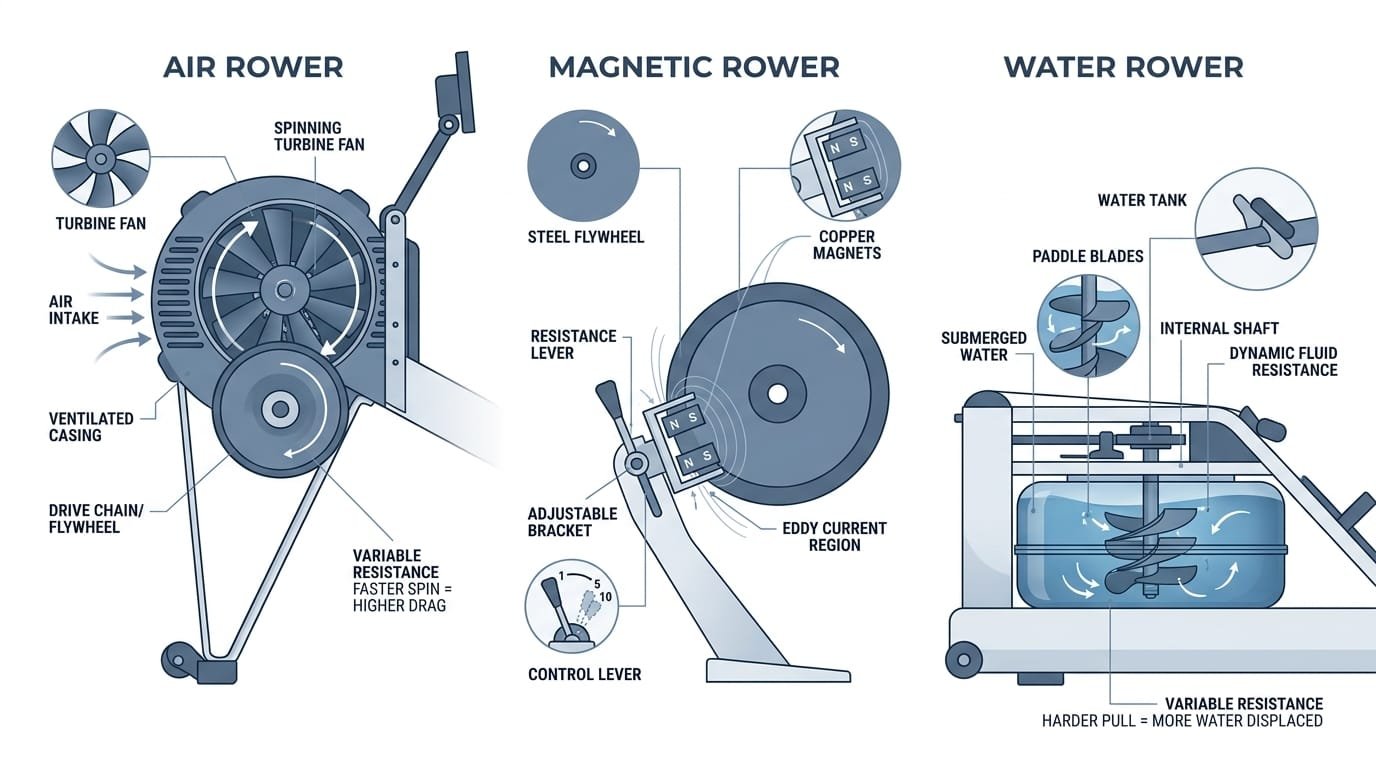
Air Resistance A flywheel with fan blades spins inside a cage. The harder and faster you pull, the more air resistance is generated. Resistance scales automatically with effort. Most models include a damper setting that adjusts airflow and changes the “feel” of the stroke (lighter and quicker at low settings, heavier at high settings).
Magnetic Resistance Magnets positioned near a flywheel create resistance without physical contact. Resistance is set in discrete levels (manual dial or electronic controls) and remains consistent throughout the stroke once selected. Operation is nearly silent.
Water Resistance A paddle moves through a tank of water. Resistance scales with effort in a fluid way that closely mimics on-water rowing. The characteristic whooshing sound is often described as soothing. Water level can be adjusted to change overall resistance.
Head-to-Head Comparison
| Feature | Air Rower | Magnetic Rower | Water Rower |
|---|---|---|---|
| Resistance Feel | Dynamic, scales with effort | Consistent at set level | Fluid, closest to real water |
| Noise Level | Loudest (fan noise) | Quietest | Moderate (water whoosh) |
| Progressive Overload | Excellent (unlimited) | Limited to discrete levels | Good (effort-scaled) |
| Maintenance | Low (clean fan, occasional chain oil) | Very low | Moderate (tablets, water changes) |
| Typical Price Range | $400–$1,200+ | $200–$2,000+ | $500–$2,200+ |
| Best Environment | Garage, dedicated gym | Apartment, shared living | Living room, aesthetic priority |
| Data Accuracy | Highest (industry standard) | Variable | Moderate |
| Storage | Often splits or stands vertical | Many fold | Often stands vertical, heavier |
Detailed Pros and Cons
Air Rowers Pros: Most realistic progressive resistance for performance training and HIIT; excellent durability on quality models; industry-standard metrics that allow accurate tracking and comparison; no electricity required on many models. Cons: Noticeable fan noise; can feel light at very low intensities; basic monitors on some classic models. Best for: Serious training, CrossFit-style intervals, competitive athletes, garage gyms.
Magnetic Rowers Pros: Near-silent operation; smooth and consistent stroke; often include advanced programming, screens, and app connectivity; many compact or foldable designs. Cons: Resistance does not scale automatically with effort; fixed levels can feel limiting for high-intensity work; cheaper models may lack durability. Best for: Apartments, early-morning or late-night sessions, users who prioritize quiet and guided workouts.
Water Rowers Pros: Most authentic on-water sensation and sound; attractive wooden frames on many models; smooth, fluid resistance that scales with effort. Cons: Heavier and often larger; requires periodic water treatment to prevent algae; water level adjustment is less precise than magnetic levels; higher maintenance. Best for: Users who value the sensory experience and aesthetics, technique-focused training.
Step-by-Step Buying Process
- Define your top priorities: noise level, training intensity, space, budget, and whether you want interactive programming.
- Measure available floor space and confirm ceiling height for vertical storage if needed.
- Check user weight capacity and rail length (taller users need longer rails).
- Decide on resistance type using the comparison above.
- Evaluate monitor quality, connectivity (Bluetooth, apps), and whether a subscription is required.
- Review warranty length and what it covers (frame vs. parts vs. electronics).
- Consider long-term costs (subscriptions, water tablets, potential repairs).
- Read recent user feedback on durability, seat comfort, and customer support.
- Confirm return policy and delivery details—rowers are large and heavy.
Key Features Beyond Resistance Type
- Seat and handle comfort: A supportive seat and ergonomic handle reduce fatigue on longer sessions.
- Footrest adjustability: Secure, adjustable footplates accommodate different shoe sizes and foot positions.
- Monitor and metrics: Look for stroke rate, split times, watts, distance, and calories. Concept2’s PM5 remains the gold standard for accuracy.
- Connectivity: Bluetooth FTMS compatibility allows use with popular training apps.
- Storage: Vertical storage or folding designs save space in smaller homes.
- Build quality: Steel frames and robust rails last longer under frequent use.
Integrating a Rower into Your Home Training
Rowing complements strength work extremely well. Use it for warm-ups, finishers, or dedicated cardio days. Short high-intensity intervals pair nicely with kettlebell complexes or dumbbell circuits. Steady-state rows support recovery between heavier lifting sessions on a bench or power rack.
Maintain strong grip endurance and scapular control—the same principles that improve lateral raise form also keep the shoulders healthy during high-volume rowing. Proper chain or handle technique prevents overuse issues in the elbows and lower back.
Common Mistakes to Avoid
- Buying the quietest or cheapest option without considering training goals.
- Ignoring rail length if you are tall.
- Underestimating noise in an apartment.
- Overlooking long-term subscription costs on smart rowers.
- Choosing a machine with a low weight capacity or flimsy construction.
- Neglecting proper form—rowing with rounded back or incomplete leg drive reduces benefits and increases injury risk.
Frequently Asked Questions
Which type of rowing machine is best overall? Air rowers, particularly the Concept2 RowErg, are the most widely recommended for performance, durability, and long-term value. Magnetic is better when noise is the limiting factor.
Are magnetic rowers good for serious training? They work well for steady-state cardio and general fitness. For high-intensity intervals and maximum progressive resistance, air is superior.
Do water rowers need a lot of maintenance? Moderate. Add purification tablets periodically and change the water according to the manufacturer’s schedule to prevent algae and keep the system clean.
How much space does a rowing machine need? Most require 7–8 feet of length in use. Many air and water models store vertically; many magnetic models fold.
Is the Concept2 worth the price? For most users focused on training quality and longevity, yes. It holds value well and is the benchmark against which other machines are measured.
Can I use a rower every day? Yes, provided you manage volume, maintain good form, and allow recovery. Alternate intensity levels to avoid overuse.
Final Recommendation
Match the resistance type to your environment and goals. Choose an air rower if training quality and progressive resistance are the priority and noise is acceptable. Choose magnetic if you need quiet operation in a shared living space. Choose water if the sensory experience and aesthetics matter most and you are willing to perform light maintenance.
Measure your space, set a realistic budget that includes any subscription costs, and prioritize build quality and user capacity. A well-chosen rower becomes one of the most effective and joint-friendly cardio tools in a home gym.
Define your non-negotiables (noise, space, intensity), select the matching resistance type, and invest in a machine that will support consistent training for years. Consistent rowing combined with strength work delivers excellent full-body results with minimal impact on the joints.