Holiday and Travel Workouts Using Only What You Can Pack or Find
Quick Answer
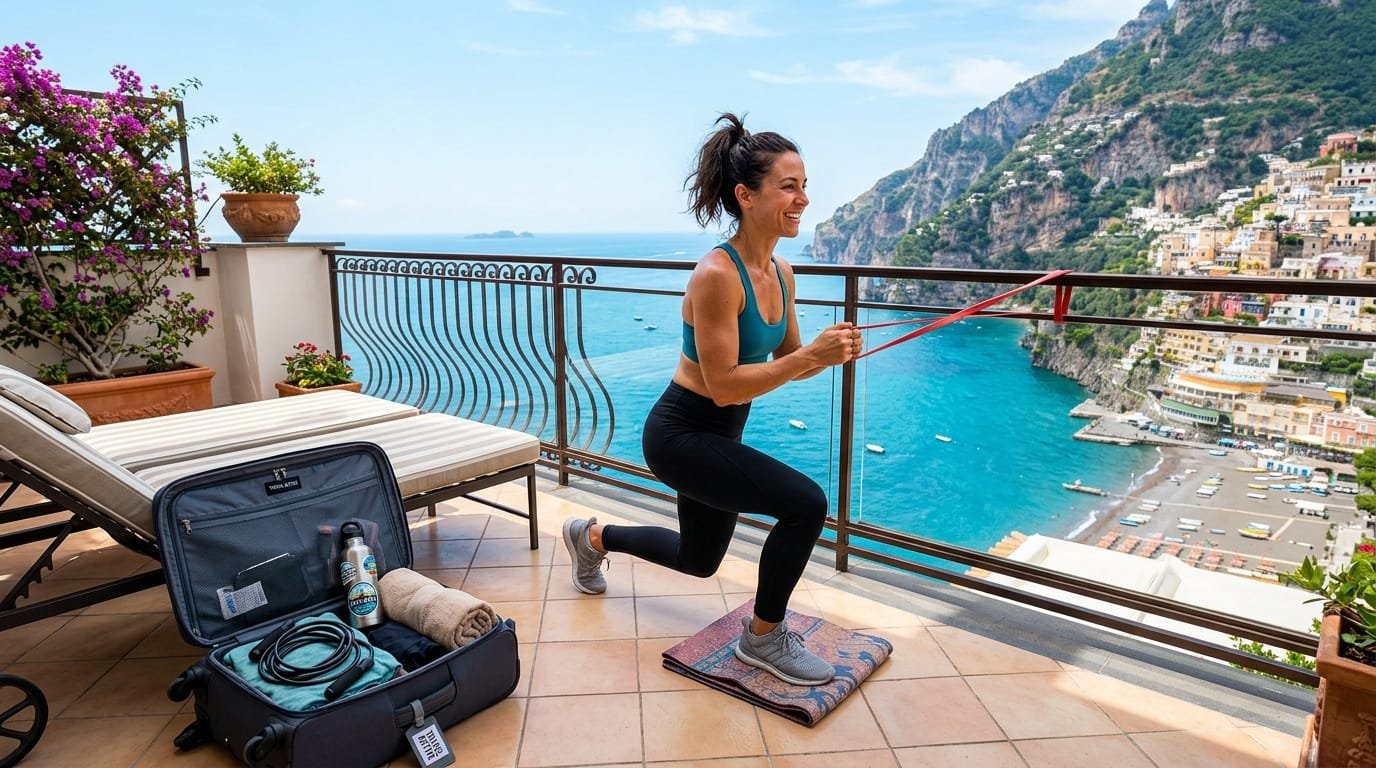
Effective holiday and travel workouts rely on bodyweight exercises, a light resistance band or two, and whatever sturdy structures you can find (hotel desk, park bench, door frame, or floor space). Focus on full-body compound movements performed with progressive difficulty through tempo, pauses, unilateral variations, and density. Two to four short sessions per week maintain strength and conditioning without specialised equipment. Pack a single band or pair of light bands, plan minimum viable workouts in advance, and treat travel training as consistency maintenance rather than peak performance.
The Reality of Training Away from Home
Travel and holidays disrupt normal routines, equipment access, and schedules. The goal shifts from progressive overload to maintenance of strength, movement quality, and the training habit. Trying to replicate full home or gym sessions usually fails. Success comes from accepting limited tools and maximising what is available: your body, a small amount of portable resistance, and the environment around you.
What to Pack (Minimal and Effective)
| Item | Why It Is Worth Packing | Space / Weight Impact |
|---|---|---|
| One or two resistance bands (light + medium) | Adds progressive resistance to squats, rows, presses, and pulls | Very low |
| Jump rope (optional) | Efficient conditioning | Low |
| Suspension trainer or door-anchor straps (optional) | Enables rows and face-pull variations | Low–moderate |
| Nothing extra | Pure bodyweight is already highly effective | Zero |
Most travellers do well with a single medium-strength band or simply bodyweight. Anything more is optional.
Core Movement Patterns and Travel Solutions
Squat / Lunge Pattern
- Bodyweight squat, reverse lunge, walking lunge, Bulgarian split squat (rear foot on bed, chair, or bench)
- Progress with slower tempo, pauses, or single-leg emphasis
Hinge Pattern
- Single-leg Romanian deadlift (bodyweight), good-morning style hinge, glute bridge or single-leg bridge
- Band can be added around hips or under foot for extra tension
Horizontal Push
- Push-up variations (elevated, standard, decline using bed or chair, archer progressions)
- Band-resisted push-ups if a band is available
Horizontal Pull
- Inverted rows under a sturdy table or using a suspension trainer
- Band rows or face pulls anchored in a door
- Towel rows around a post or railing if outdoors
Vertical Push / Pull (when possible)
- Pike push-up progressions
- Doorway or playground pull-up / hang variations
- Band pulldowns if an anchor exists
Core and Conditioning
- Plank variations, dead bugs, suitcase carries with a backpack
- Jump rope, stair climbing, or brisk walking
Shoulder-friendly technique remains important even with limited equipment (Bent Arms vs. Straight Arms in Lateral Raises, The Hidden Mistake in Lateral Raises, and 3 Lateral Raise Modifications). Grip strength can be maintained with towel grips, hangs, or band work (Do Hand Grippers Really Work?).
Sample Travel Workouts (20–35 Minutes)
Minimal Bodyweight Session
- Bulgarian split squat or reverse lunge – 3 sets of 8–12 per leg
- Single-leg Romanian deadlift – 3 sets of 8–12 per leg
- Push-up variation – 3 sets of 8–15
- Inverted row or table row – 3 sets of 8–12
- Plank or dead bug – 2 sets
Band-Enhanced Session
- Band goblet-style squat or good-morning – 3 sets
- Single-leg RDL with band – 3 sets per leg
- Band floor press or push-up – 3 sets
- Band row or face pull – 3 sets
- Optional carry or core work
Hotel Room Density Circuit
Set a timer for 20–25 minutes. Rotate through four movements (lunge, hinge, push, pull), performing 6–10 controlled repetitions each round. Rest only as needed to keep form clean. Track total rounds and try to improve across the trip.
Step-by-Step Travel Training Plan
- Decide the realistic number of sessions you can complete during the trip.
- Pack one band (or commit to pure bodyweight).
- Write two or three minimum viable workouts in advance.
- On arrival, identify usable anchors: desk, table, door, park bench, playground, stairs.
- Schedule sessions in the calendar like any other appointment.
- Use tempo, pauses, and unilateral variations for progressive difficulty.
- Keep sessions short (20–35 minutes) to protect adherence.
- Track completed sessions simply (checkmarks are enough).
- Prioritise sleep and walking as supporting recovery and conditioning.
- Resume normal training promptly on return without trying to “make up” missed volume.
Progressive Overload Strategies While Travelling
Even with limited tools you can still create progressive demand:
- Slow the eccentric phase (3–5 seconds)
- Add pauses at the hardest point
- Move to unilateral or more leveraged versions
- Increase density (more work in the same time)
- Improve range of motion or control
These methods maintain a training stimulus without heavier equipment.
Environment-Specific Options
Hotel Room
Push-ups, lunges, single-leg hinges, bed- or chair-supported Bulgarian split squats, table inverted rows, band exercises with door anchor.
Outdoor / Park
Bench step-ups or decline push-ups, playground pull-ups or inverted rows, hill walks or sprints, single-leg work on level ground.
Limited Hotel Gym
Use whatever dumbbells or cables exist for the main patterns. Keep the same full-body structure and short time frame.
Family or Shared Accommodation
Early morning or late evening sessions, short density circuits, or outdoor bodyweight work to minimise disruption.
Managing Expectations and Mindset
Travel training is primarily about consistency and maintenance. Strength may not increase, but it can be largely preserved. Accepting this reduces frustration and makes short sessions feel successful. The habit of showing up while away from home is more valuable than any single workout performance.
Recovery and Lifestyle Factors on the Road
- Protect sleep as much as the schedule allows
- Walk regularly—daily steps support conditioning and recovery
- Stay hydrated and keep protein intake reasonable
- Avoid the urge to compensate with excessive training volume on return
Common Travel Training Mistakes
| Mistake | Result | Better Approach |
|---|---|---|
| Trying to replicate full home workouts | Missed sessions and frustration | Use minimum viable full-body sessions |
| Packing too much equipment | Unnecessary hassle | One band or pure bodyweight |
| Waiting for perfect conditions | Skipped workouts | Train in the available space |
| No plan before departure | Decision fatigue on the road | Write sessions in advance |
| Complete inactivity | Greater strength loss and harder restart | Maintain minimum frequency |
| Over-training on return | Unnecessary fatigue | Resume normal programme gradually |
Strength training remains highly effective for maintaining muscle and function even with reduced equipment and frequency (strength training guidance). Practical home-gym approaches emphasise adaptable systems that survive travel and disrupted routines (home gym equipment prioritisation and budget home gym principles).
Frequently Asked Questions
How often should I train while travelling?
Two to four short sessions per week is realistic and effective for maintenance. Even one quality session per week is better than none.
Is a resistance band really necessary?
No, but it expands options and makes progressive resistance easier. Pure bodyweight works well when leverage and tempo are manipulated.
What if I have no place to do inverted rows?
Use band rows with a door anchor, towel rows around a sturdy post, or focus on single-arm band or backpack rows. Pushing and lower-body work can still be prioritised.
Can I maintain strength with only bodyweight for two weeks?
Yes for most people, especially when intensity (tempo, pauses, unilateral difficulty) remains high.
Should I do longer sessions when I find a hotel gym?
Only if recovery and schedule allow. Short, focused sessions are still preferable to occasional marathon workouts.
How do I handle early mornings or late nights with family?
Prepare a silent 15–20 minute routine that requires minimal space and no equipment changes. Consistency matters more than perfection.
What about conditioning while travelling?
Walking, stairs, jump rope, or short density circuits cover most needs without complex programming.
How quickly should I return to normal training after a trip?
Resume the regular programme within a few days. Avoid sudden large increases in volume.
Final Recommendation
Holiday and travel workouts succeed when they are simple, portable, and focused on consistency rather than peak performance. Pack a resistance band if possible, master a small menu of bodyweight and band exercises that cover the main movement patterns, and use tempo, pauses, and unilateral variations for progressive difficulty. Schedule short full-body sessions in advance and treat them as non-negotiable appointments.
Prepare your minimum viable workouts before you leave, identify usable anchors on arrival, and keep sessions inside 20–35 minutes. This approach maintains strength, movement quality, and the training habit so that progress resumes smoothly when you return home. Pack light, plan simply, and train consistently—the results will follow even when equipment is limited.