Scapular Control Explained: Why Your Shoulders Feel Unstable on Presses
Quick Answer
Shoulders often feel unstable on presses because the scapulae (shoulder blades) are not providing a stable, well-timed base of support. Optimal pressing requires the scapulae to retract and depress slightly for a solid platform, then move through controlled upward rotation and protraction as the arms travel overhead or forward. When the scapulae wing, shrug excessively, or fail to rotate properly, the glenohumeral joint loses stability and the rotator cuff and surrounding tissues are forced to overwork. Improving scapular control through targeted drills, better pressing setup, and balanced pulling volume usually eliminates the unstable feeling and makes presses stronger and safer.
What Scapular Control Actually Means
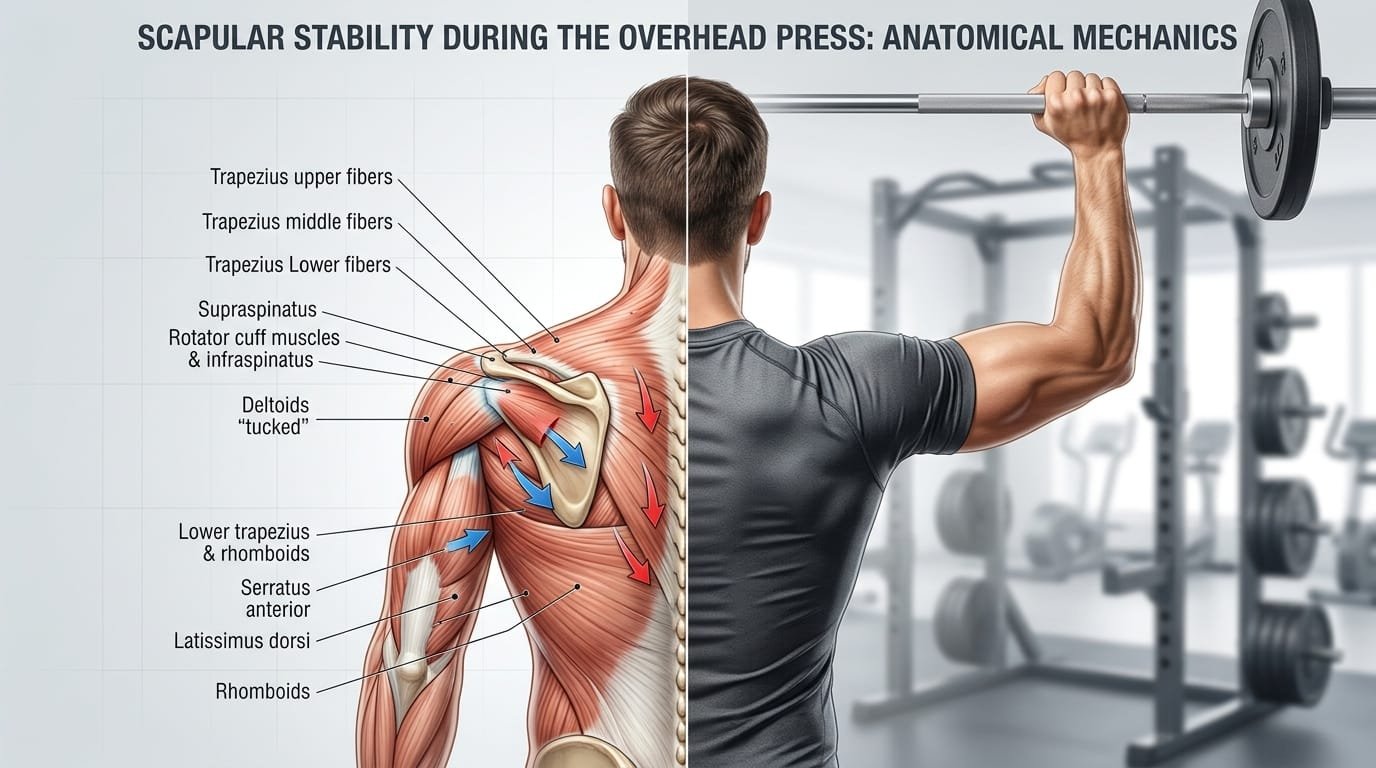
The scapula is a flat, triangular bone that glides on the posterior ribcage. It has no direct bony attachment to the axial skeleton except through the clavicle, so its position and movement depend almost entirely on muscle control. The key muscles include:
- Serratus anterior – protracts and upwardly rotates the scapula
- Lower and middle trapezius – depress and retract
- Rhomboids – retract
- Upper trapezius and levator scapulae – elevate and upwardly rotate (in coordination)
- Pectoralis minor – can pull the scapula into excessive anterior tilt if overactive
“Scapular control” means the ability to position the shoulder blades optimally and then move them smoothly through the required ranges while the arm is loaded. Without this control, the ball-and-socket joint of the shoulder has an unstable platform and feels unreliable under load.
Why Poor Scapular Control Makes Presses Feel Unstable
During a bench press, floor press, or overhead press the scapulae must:
- Create a stable base (usually mild retraction and depression on the bench).
- Allow coordinated upward rotation and posterior tilt as the arms move.
- Avoid excessive elevation (shrugging) or winging.
When these actions are missing or poorly timed:
- The humeral head can shift forward or upward in the socket.
- The rotator cuff works overtime to centre the joint.
- Force transfer from the torso to the arms becomes inefficient.
- The lifter experiences a sensation of the shoulder “slipping,” “shifting,” or lacking a solid platform.
This is especially noticeable near lockout on overhead presses or at the bottom of bench presses when the scapulae are poorly set.
Common Scapular Dysfunctions That Affect Pressing
| Dysfunction | What It Looks/Feels Like | Effect on Presses |
|---|---|---|
| Excessive elevation (shrugging) | Shoulders rise toward the ears | Reduces stable base, increases upper-trap dominance |
| Winging | Medial border of the scapula lifts off the ribcage | Loss of serratus control, unstable platform |
| Anterior tilt | Bottom of the scapula kicks outward | Encourages internal rotation and forward humeral head |
| Insufficient upward rotation | Scapula fails to rotate as the arm elevates | Impingement risk and weak lockout |
| Over-retraction without control | Scapulae pinched hard but immobile | Restricts natural movement and can create stiffness |
How to Assess Your Own Scapular Control
Wall slide or wall angel
Stand with back against a wall, arms in a “goal-post” position. Slide the arms upward while keeping the backs of the hands, elbows, and shoulders in contact with the wall. Watch or film for winging, shrugging, or loss of contact.
Scapular push-up
In a high plank or kneeling position, keep the arms straight and move only the shoulder blades—protract (spread) at the top and allow controlled retraction. Look for winging or inability to isolate the movement.
Overhead reach test
Raise both arms overhead while watching the scapulae in a mirror or on video. Note whether they rotate smoothly or shrug early.
These simple tests quickly reveal whether control or timing is lacking.
Step-by-Step Plan to Improve Scapular Control for Pressing
1. Restore basic awareness and isolated control (1–2 weeks)
- Scapular push-ups: 2–3 sets of 8–12
- Prone Y-T-W raises with very light or no weight
- Band pull-aparts and face pulls focusing on scapular movement
- Wall slides with pause and control
2. Integrate control into supported positions
- Floor press or bench press with deliberate scapular set (retract and depress before unracking)
- Overhead carries or bottoms-up kettlebell holds to challenge stability
3. Add dynamic control under load
- Landmine press or single-arm dumbbell press with focus on smooth scapular upward rotation
- Controlled tempo overhead presses, stopping short of any painful or unstable range
4. Balance the program
Ensure horizontal and vertical pulling volume at least matches pressing volume. Strong mid-back and serratus function make scapular control far easier.
5. Re-test and progress
Revisit the wall-slide and scapular push-up assessments every 2–3 weeks. Progress load on presses only when the scapulae feel stable and controlled.
Technique Cues for Stable Pressing
Bench or floor press
- Retract and depress the scapulae before taking the weight.
- Maintain that “set” position as a stable platform; do not let the shoulder blades wing or shrug during the rep.
- Think “bend the bar” or “screw the hands outward” to create additional external-rotation stability.
Overhead press
- Start with the scapulae in a neutral-to-slightly-retracted position.
- Allow smooth upward rotation as the bar or dumbbells travel overhead.
- Avoid early shrugging; drive through the upper back and serratus.
- Finish with the biceps near the ears and the scapulae upwardly rotated, not elevated by the upper traps.
Detailed guidance on related shoulder-friendly raising patterns can be found in Bent Arms vs. Straight Arms in Lateral Raises, The Hidden Mistake in Lateral Raises, and 3 Lateral Raise Modifications.
Supporting Mobility and Soft-Tissue Work
- Thoracic extension drills (foam roller or seated extensions)
- Gentle pec and lat mobility to reduce excessive anterior pull on the scapulae
- Posterior shoulder and rotator-cuff endurance work
- Grip and forearm strength for better overall upper-limb stability (Do Hand Grippers Really Work?)
Programming Recommendations
- Include 2–3 scapular-control drills in every upper-body warm-up.
- Keep pressing volume moderate while rebuilding control.
- Prioritise quality of scapular movement over maximal load for several weeks.
- Balance every pressing session with horizontal pulling (rows) and some vertical pulling.
- Use higher-repetition, controlled sets for accessory scapular work.
Strength training performed with good scapular mechanics remains one of the most effective ways to build resilient shoulders (strength training guidance). Practical home-gym approaches emphasise foundational control before heavy loading (home gym equipment prioritisation and budget home gym principles).
Common Mistakes That Perpetuate Instability
| Mistake | Result | Correction |
|---|---|---|
| Ignoring scapular position on setup | Unstable platform from the first rep | Deliberately set and hold the scapulae |
| Over-relying on upper traps | Elevation instead of upward rotation | Cue “shoulders down, reach long” |
| Neglecting serratus anterior | Winging and poor protraction | Daily scapular push-ups and band punches |
| Excessive pressing volume without pulling | Muscular imbalance | Match or exceed pressing with rowing |
| Pushing through the unstable feeling | Reinforces poor motor patterns | Reduce load and rebuild control first |
| Skipping thoracic mobility | Restricted scapular movement | Add extension work regularly |
Frequently Asked Questions
Why do my shoulders feel fine on machines but unstable with free weights?
Machines provide external stability that masks poor scapular control. Free-weight presses demand that your own scapular muscles create the platform.
How long does it take to improve scapular control?
Noticeable improvement often occurs within 2–4 weeks of consistent daily drills. Full integration under heavy loads may take 6–12 weeks.
Can I keep pressing while fixing the problem?
Yes, but reduce load and volume, and prioritise perfect scapular positioning on every set. Regress to floor presses or landmine presses if needed.
Is winging always a problem?
Visible winging under load usually indicates insufficient serratus or lower-trapezius strength and should be addressed. Mild movement is normal; excessive winging is not.
Do I need special equipment?
No. Bodyweight scapular push-ups, resistance bands, and light dumbbells are sufficient for most corrective work.
Should I retract hard and hold throughout the entire overhead press?
No. Some retraction at the start is useful, but the scapulae must upwardly rotate as the arms elevate. A completely fixed scapula restricts natural movement.
Can poor posture contribute to this issue?
Yes. Rounded upper-back posture and forward shoulders make optimal scapular positioning more difficult. Thoracic mobility and postural awareness help.
When should I seek professional help?
If instability is accompanied by pain, clicking, true subluxation, or does not improve after 4–6 weeks of consistent corrective work, consult a qualified clinician.
Final Recommendation
Shoulders that feel unstable on presses are usually a scapular-control problem, not a pure rotator-cuff or “weak shoulder” problem. The scapulae must provide a stable yet mobile base—set for pressing, then rotating and protracting in coordination with the arms. When this sequencing is missing, the glenohumeral joint feels unreliable and the smaller stabilisers are overloaded.
Restore isolated control with scapular push-ups, wall slides, and band work, then integrate that control into every pressing set. Balance pressing volume with sufficient pulling, maintain thoracic mobility, and progress load only when the scapulae feel solid.
Begin the corrective drills today, film your presses to check scapular behaviour, and treat scapular position as a non-negotiable part of setup. Once control improves, presses become stronger, more stable, and far more comfortable. Scapular control is a trainable skill—master it and the unstable feeling on presses largely disappears.