Free Weights vs. Machines for Home Gyms: Pros, Cons, and Hybrid Approach
Quick Answer
For home gyms, free weights (dumbbells, kettlebells, barbells) generally offer greater versatility, functional strength, space efficiency, and long-term progression at lower cost, while machines provide guided movement paths, easier isolation, and higher perceived safety when training alone. Research shows both build similar amounts of muscle when volume and effort are matched; strength gains are largely specific to the modality used. The optimal solution for most home lifters is a hybrid approach: free weights as the foundation for compound movements and progressive overload, with select machines or machine-like tools (cable systems, Smith machines, or guided plate-loaded units) added for isolation, safety on heavy efforts, or variety when space and budget allow.
Understanding the Core Differences in a Home Setting
Free weights require the lifter to control the load in three-dimensional space. This demands greater stabiliser activation, core engagement, and coordination. Machines constrain the load to a fixed path, reducing the need for balance and allowing the target muscle to be stressed with less technical demand.
In a commercial gym the choice is abundant. In a home gym the decision is constrained by floor space, ceiling height, budget, noise, and the reality of training without a spotter. These practical factors often matter as much as pure physiological differences.
Evidence Summary: Muscle Growth and Strength
Multiple analyses and reviews indicate:
- Hypertrophy: When sets, proximity to failure, and weekly volume are equated, free weights and machines produce comparable muscle growth.
- Strength: Gains are modality-specific. Free-weight training improves free-weight strength more; machine training improves machine strength more.
- Stabiliser and functional carry-over: Free weights generally produce greater demand on stabilisers and transfer better to real-world and athletic movements.
- Safety and isolation: Machines make it easier to push close to failure with reduced risk of being pinned and allow more targeted isolation.
For pure muscle size, both tools work. For overall strength, coordination, and home-gym practicality, free weights usually form the more efficient foundation.
Pros and Cons for Home Gyms
| Factor | Free Weights (Dumbbells, Kettlebells, Barbell) | Machines (Cable, Smith, Plate-Loaded, Selectorised) | Home-Gym Implication |
|---|---|---|---|
| Space efficiency | High (especially adjustable dumbbells & kettlebells) | Low to moderate (most units are bulky) | Free weights win for small spaces |
| Cost | Lower long-term cost per exercise | Higher per station | Free weights more budget-friendly |
| Versatility | Extremely high – hundreds of exercises | Limited to the machine’s movement path | Free weights cover full programmes |
| Progressive overload | Excellent and precise | Excellent but often larger jumps | Both effective |
| Safety when alone | Lower on maximal barbell efforts | Higher – guided path, safety stops | Machines advantageous for heavy solo work |
| Stabiliser demand | High | Low | Free weights better for functional strength |
| Learning curve | Steeper | Shallower | Machines easier for absolute beginners |
| Noise & flooring stress | Can be higher (dropped weights) | Generally quieter | Context-dependent |
| Muscle growth potential | Excellent | Excellent | Equal when programmed well |
| Long-term ceiling | Very high | High but limited by available machines | Free weights scale better |
Free Weights – Detailed Advantages and Drawbacks in the Home
Advantages
- One pair of adjustable dumbbells or a barbell + plates can train every major movement pattern.
- Greater core and stabiliser activation.
- Clear, small progression steps.
- Minimal footprint with adjustable options.
- High transfer to daily activities and sports.
- Easy to expand gradually (add kettlebells, bands, a bench).
Drawbacks
- Higher technical demand — form breakdown under fatigue is more consequential.
- Maximal barbell efforts (especially bench press or squats) carry risk without a spotter or safety rack.
- Steeper learning curve for complex lifts.
- Potential for more noise and floor impact.
Machines – Detailed Advantages and Drawbacks in the Home
Advantages
- Guided path reduces technical demand and allows safer training to failure.
- Excellent for isolation (leg extensions, leg curls, pec deck-style movements, cable flyes).
- Useful for rehabilitation or when stabilisers are fatigued.
- Consistent resistance curves on quality units.
- Lower coordination requirement for beginners.
Drawbacks
- High cost and large footprint for each movement pattern.
- Limited exercise variety per machine.
- Less stabiliser and core development.
- Strength gains transfer less effectively to free-weight or real-world tasks.
- Many home “machines” are lower quality or lack proper weight stacks.
The Hybrid Approach – Best of Both Worlds for Home Gyms
Most effective home gyms combine both:
Foundation (60–80% of training)
- Adjustable dumbbells or barbell for squats, hinges, presses, rows, and overhead work.
- Kettlebells for swings, carries, and conditioning.
- Bodyweight and band work for pull-ups, face pulls, and activation.
Supplement (20–40% of training)
- Cable column or functional trainer for flyes, face pulls, lateral raises, and single-arm work.
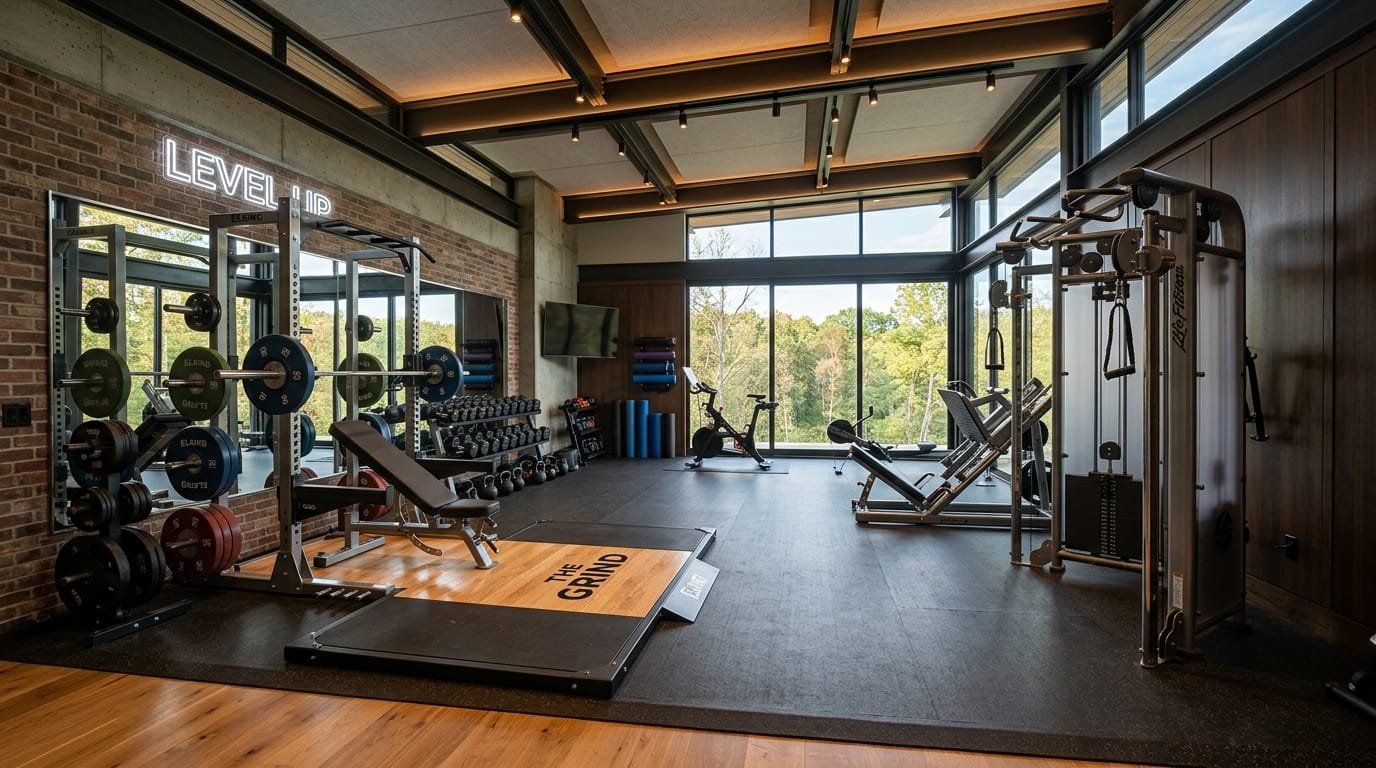
- Optional Smith machine or guided squat/press station for heavy solo efforts with safety stops.
- Small isolation machines only if space and budget are abundant (leg curl/extension, preacher curl, etc.).
This hybrid maximises muscle growth potential, functional strength, safety, and space efficiency.
Step-by-Step Home Gym Decision Framework
- Measure available floor space and ceiling height.
- Set a realistic budget (equipment + flooring + accessories).
- Prioritise movement patterns: squat, hinge, horizontal push/pull, vertical push/pull, core, carries.
- Start with free weights that cover the majority of patterns (adjustable dumbbells + bench + pull-up bar is a powerful minimal base).
- Add a cable solution or safety-equipped bar station if heavy solo barbell work is desired.
- Incorporate resistance bands for warm-ups, lateral raises, and travel.
- Only add single-purpose machines after the foundational tools are solid.
- Design the layout so equipment can be used without constant rearrangement.
- Invest in proper flooring to protect joints and the house.
- Reassess every 6–12 months and expand based on actual usage and goals.
Sample Hybrid Home Programming
Lower-Body Emphasis Day
- Free-weight squat variation or Bulgarian split squat
- Romanian deadlift or kettlebell swing
- Optional machine leg curl or cable pull-through
- Calf work and core
Upper-Body Emphasis Day
- Dumbbell or barbell press
- Single-arm dumbbell or cable row
- Overhead press or lateral raise (dumbbell or cable)
- Face pulls and band pull-aparts
- Arm isolation as needed
This structure captures the stabiliser benefits of free weights and the isolation/safety benefits of cables or machines.
Integrating with Existing Home Training Elements
Free weights and any machine additions should support balanced programming. Maintain shoulder health with proper lateral-raise form and dedicated rear-delt work (safe lateral-raise technique and shoulder health routine).
Kettlebells remain one of the most space-efficient free-weight tools (kettlebell sizing guide. Grip strength improves performance with heavier free weights and carrying variations (grip strength guidance.
Bands bridge free weights and machine-like accommodating resistance (Resistance Bands Buying Guide. Core progressions such as the ab roller fit either approach. Conditioning options including treadmill work complement strength training (manual treadmill guidance.
Recovery practices allow progressive overload on both free weights and machines (Best Post-Workout Recovery Tools, Best Massage Gun for Post-Workout Recovery on a Budget, and Sleep and Recovery Strategies. Tracking progress is essential regardless of tool (Best Ways to Track Progress Without a Gym or Personal Trainer.
External reviews confirm that hypertrophy is similar between modalities while strength is specific, supporting a hybrid approach for most goals (free weights vs machines analysis and related evidence summaries).
Common Mistakes in Home Gym Equipment Choices
- Buying multiple large machines before owning versatile free weights
- Assuming machines are inherently “safer” without learning proper setup and ranges
- Neglecting stabiliser work entirely when machines dominate
- Choosing free weights without a plan for safety on heavy barbell efforts
- Ignoring floor protection and noise considerations
- Failing to programme progressive overload on whichever tools are owned
Frequently Asked Questions
Do free weights build more muscle than machines?
No. When volume and effort are matched, muscle growth is similar. Free weights offer advantages in stabiliser development and functional strength.
Are machines safer for training alone?
Guided machines and those with safety stops reduce the risk of being pinned. Free weights require more technical proficiency and, for heavy barbell work, a rack with safety arms or careful load selection.
What is the best starting setup for a small home gym?
Adjustable dumbbells, a sturdy bench, a pull-up bar, and resistance bands cover the majority of needs cost-effectively and space-efficiently.
Can I build a complete physique with only free weights at home?
Yes. Countless trainees have done so. Machines are optional enhancements, not requirements.
Should beginners start with machines?
Machines can reduce technical barriers early on, but learning free-weight patterns under control builds more transferable skill. A mix or free-weight focus with lighter loads works well.
How important is a power rack or Smith machine at home?
Useful if you want to perform heavy barbell squats and bench presses safely alone. Many lifters progress very far with dumbbells and kettlebells only.
Do I need both for optimal results?
Not strictly, but a hybrid approach often provides the best combination of growth, strength, safety, and variety within home constraints.
Final Recommendation
For home gyms, free weights should form the foundation because of their versatility, space efficiency, cost-effectiveness, and superior development of stabilisers and functional strength. Machines (particularly cable systems or safety-equipped guided stations) are valuable additions for isolation, safer heavy efforts, and variety. Research shows both build muscle equally well when programmed properly; the practical constraints of home training favour starting with free weights and layering machines selectively.
Build your home gym around adjustable dumbbells, kettlebells, a bench, and a pull-up solution first. Add cables or a rack when space and budget allow. Programme progressive overload, maintain balanced pushing and pulling, protect your shoulders, and recover adequately. This hybrid philosophy delivers excellent muscle growth, strength, and long-term sustainability without requiring a commercial facility. Start with the essentials, train consistently, and expand deliberately — results will follow.