Muscles Used for Sitting and Standing: How to Keep Them Strong
Quick answer: Standing up from a seated position primarily relies on your quadriceps, glutes, and hip extensors, with your core and lower back providing stability throughout the movement. This everyday action is such a reliable indicator of lower-body strength that clinicians and researchers use a standardized “sit-to-stand” test to assess functional strength, particularly in older adults — meaning keeping these muscles strong has real, measurable implications well beyond convenience.
Researched and written by the GymGoodies team, fact-checked against manufacturer specs and current fitness guidance.
Sitting down and standing back up is one of the most repeated movements in daily life — and it’s also one of the clearest windows into your actual functional strength. Understanding which muscles power this movement, and how to keep them strong, matters for everyone, not just older adults, though the stakes become particularly significant with age.
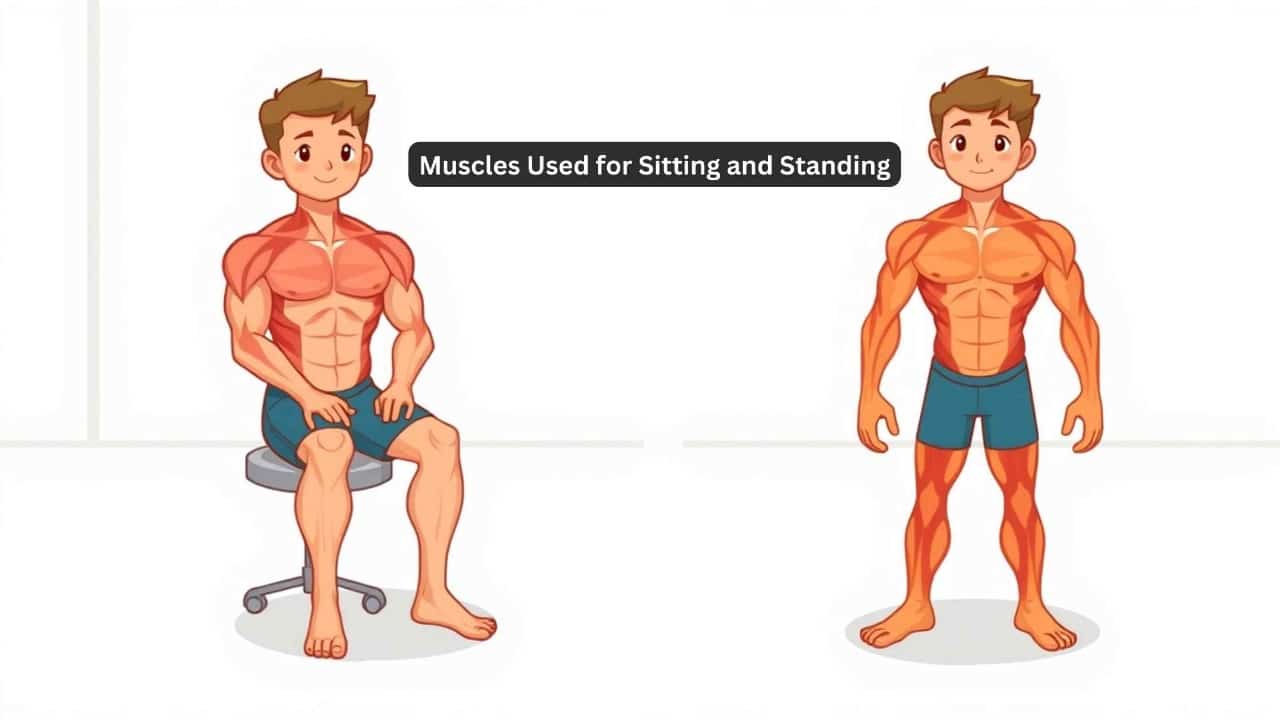
The Muscles Actually Doing the Work
Standing up from a seated position is a coordinated effort across several major muscle groups:
- Quadriceps (front of the thigh) — the primary driver of knee extension as you push up to standing
- Glutes — extend the hip, working alongside the quadriceps to power the upward movement
- Hamstrings — assist with hip extension and help control the movement, particularly during the sitting-down phase
- Core muscles — stabilize your trunk throughout the movement, preventing excessive forward lean or loss of balance
- Hip flexors — help control the initial forward-leaning phase as you shift your weight forward before standing
Why This Movement Is Used as a Genuine Clinical Assessment
This isn’t just a casual observation — the sit-to-stand movement is formalized into standardized clinical tests used specifically to assess lower-body strength and physical function. A study published in the European Review of Aging and Physical Activity examined two common sit-to-stand test variants — the Five Times Sit-to-Stand Test and the 30-Second Chair Stand Test — in a group of 887 community-dwelling adults aged 50 and older, finding meaningful relationships between sit-to-stand performance and broader measures of functional fitness and muscle mass.
These tests are widely used specifically because they’re simple to administer, require no specialized equipment, and reliably reflect real-world lower-body strength and function — meaning your ability to sit and stand comfortably and repeatedly is a legitimately meaningful strength indicator, not just an incidental daily task.
Why This Matters More As You Age
Age-related muscle loss (sarcopenia) disproportionately affects the muscles involved in this movement, and declining sit-to-stand performance is a recognized marker researchers and clinicians use to screen for this kind of functional decline. This connects directly to something we’ve covered elsewhere on this site: our guide on why bones get fragile with age discusses how muscle strength and bone health are meaningfully linked — strong lower-body muscles don’t just make standing up easier, they’re part of a broader picture of functional independence and injury resilience as you age.
Research on Directly Training This Movement
It’s not just about assessment — there’s also research on training the movement itself as an intervention. A study examining repeated sit-to-stand exercise in physically frail older adults found that a 12-week conditioning program built around repeated sit-to-stand exercises improved knee extensor strength and changed muscle activation patterns during related movements like the squat — meaning directly practicing this movement pattern is itself an effective way to build the specific strength it requires, not just a diagnostic tool for measuring it.
Exercises to Strengthen These Muscles
1. Bodyweight Sit-to-Stands (Chair Squats)
The most direct way to train this exact movement pattern:
- Sit toward the front of a sturdy chair, feet flat on the floor
- Cross your arms over your chest or extend them forward for balance
- Stand up fully, then lower back down with control
- Start with a higher, more supportive chair if needed, progressing to lower surfaces as strength improves
2. Bodyweight or Loaded Squats
Directly trains the quadriceps and glutes through a similar movement pattern with a greater range of motion, building strength that transfers well to the sit-to-stand movement specifically.
3. Glute Bridges
Isolates the glutes and hamstrings, both key contributors to the hip-extension portion of standing up from a seated position.
4. Step-Ups
Trains single-leg strength and stability, which matters since sit-to-stand transitions in daily life aren’t always perfectly symmetrical (getting up from a couch, car seat, or low chair often shifts weight unevenly).
5. Core Stabilization Work
Planks, dead bugs, or similar core exercises support the trunk stability needed to control the movement smoothly, particularly as you add load or work on faster, more repeated sit-to-stand transitions.
A Simple Self-Check: Try the 30-Second Chair Stand Test
Based on the standardized clinical test referenced in the research above, you can get a rough sense of your own lower-body functional strength:
- Sit in the middle of a sturdy, armless chair with your feet flat on the floor
- Cross your arms over your chest
- Stand up fully, then sit back down, repeating for 30 seconds
- Count how many complete repetitions you achieve
This isn’t a formal diagnostic tool without professional interpretation, but tracking your own number over time — retesting every few weeks or months as you strength train — can give you a simple, concrete way to see functional strength improvements beyond just tracking weights lifted in the gym.
Why This Matters Even If You’re Young and Healthy
It’s tempting to think of sit-to-stand strength as primarily an older-adult concern, but building strong quadriceps, glutes, and core muscles now has real preventive value — muscle mass and strength built earlier in life provide a stronger baseline to draw from as natural age-related decline begins. If you’re building a broader strength training habit, our kettlebell weight selection guide covers how to get started safely with resistance training that complements bodyweight movements like these.
Common Mistakes When Training This Movement
- Using your arms to push off during chair stands, which reduces the training demand on the actual target muscles — try to minimize arm assistance as strength improves, reserving it for safety rather than as a default crutch.
- Rushing the sitting-down phase, which is actually a valuable eccentric (controlled lowering) training stimulus for the same muscles — lower with control rather than simply dropping into the chair.
- Neglecting core stability work, assuming leg strength alone is sufficient, when trunk control meaningfully affects how efficiently and safely you perform this movement, especially as speed or load increases.
Frequently Asked Questions
How many chair stands should I be able to do in 30 seconds?
Normative values vary by age and sex, and are best interpreted by a healthcare provider or physical therapist for your specific situation — the value of this test for most people is tracking your own personal number over time rather than comparing to a fixed universal benchmark.
Is this only relevant for older adults?
No — while the clinical research focus is often on older populations due to fall-risk and independence concerns, the underlying muscles and movement pattern matter for functional strength at any age.
Can I improve my sit-to-stand strength without going to a gym?
Yes — bodyweight chair stands, squats, glute bridges, and step-ups can all be done at home with no equipment and directly build the relevant strength.
Bottom Line
Standing up from a seated position relies on a coordinated effort from your quadriceps, glutes, hamstrings, core, and hip flexors — and this everyday movement is significant enough that it’s used as an actual clinical measure of functional strength. Directly training this movement pattern, along with the muscles that power it, offers real, research-supported benefits for strength and long-term functional independence, regardless of your current age.
Have you tried the 30-second chair stand test on yourself? Let us know in the comments how many reps you managed, and whether it’s changed as you’ve built strength over time.